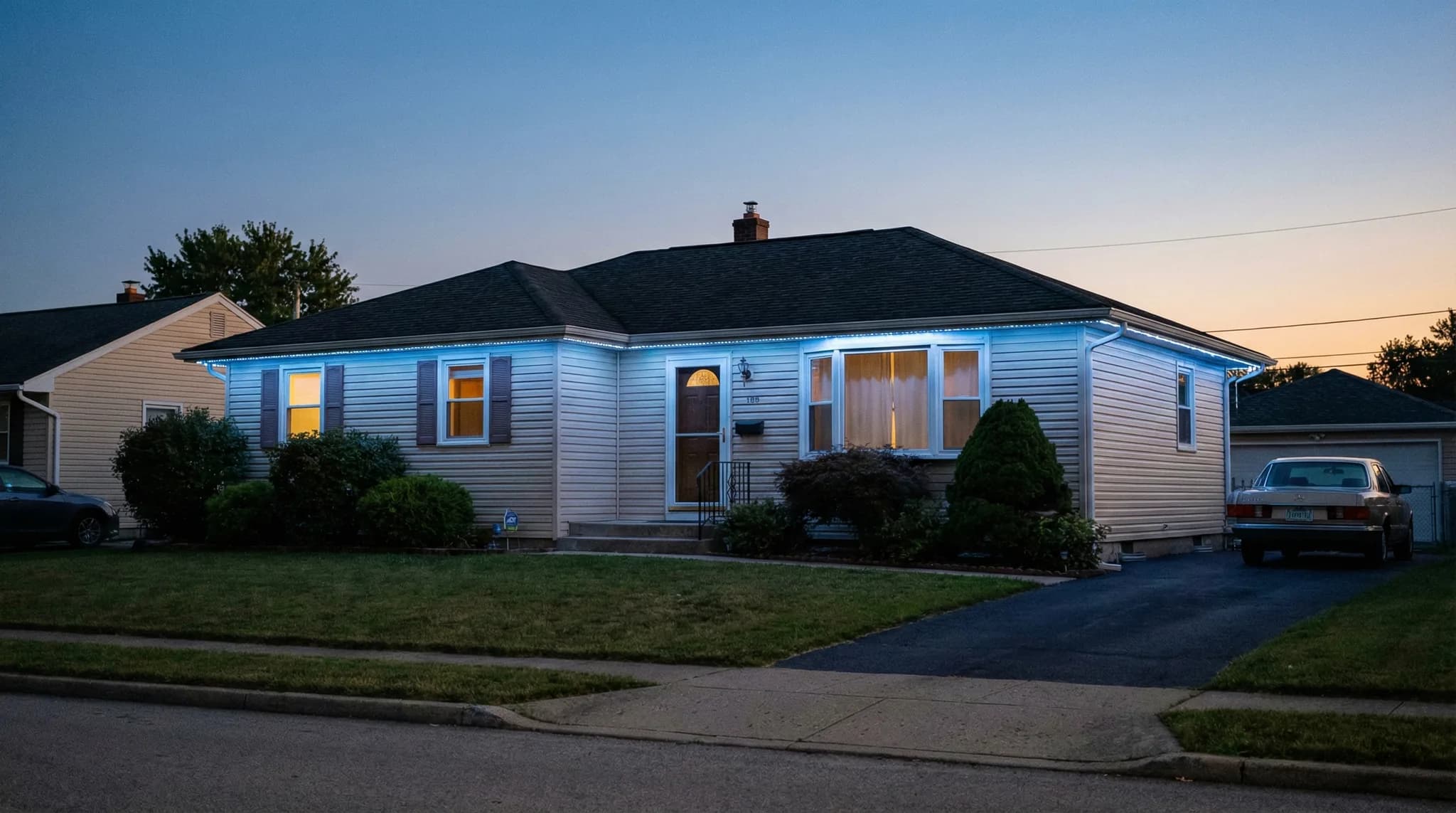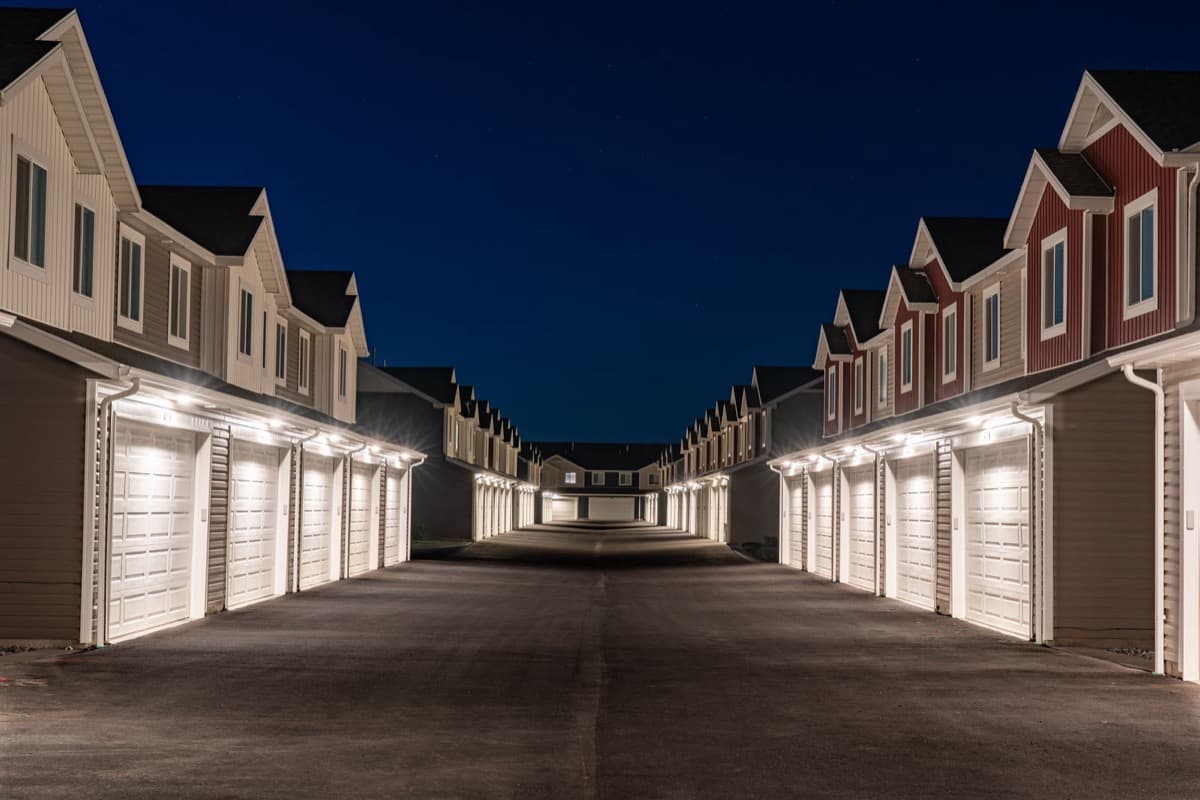
Multifamily LED lighting works at community scale: uniform rooflines, lit drive aisles, and one controller for the whole property.
Apartment community permanent outdoor lighting is a one-time capital install of commercial-grade LED channel along the rooflines, carports, clubhouse, and entry monuments of a multifamily property – run from a single app by the property manager. Yes, apartment buildings can get permanent outdoor lights, and across Sacramento, Roseville, and Rocklin they are showing up in more 2026 capital budgets as a curb appeal, safety, and marketing line item rather than a seasonal expense.
The timing is not a coincidence. Sacramento multifamily vacancy stood at 6.7% in the second quarter of 2026 with another 2,751 units under construction, according to Kidder Mathews. When renters have more choices, the properties that look cared for after dark lease faster and keep residents longer.
This guide is written for property managers, asset managers, and HOA boards. It covers where multifamily LED lighting actually goes, what it costs per structure and per community, how the five-year math compares to seasonal contract lighting, what the crime data says, and how HOA boards can approve common area roofline lights within California's assessment rules. If you manage single-family rentals instead, start with our landlord guide to permanent outdoor lights.
TL;DR: Permanent outdoor lights work on any multifamily structure with a roofline, fascia, or parapet – apartment buildings, clubhouses, carports, and entry monuments. In the Sacramento area, expect roughly $20–$50 per linear foot installed: $4,000–$9,000 for a leasing office or clubhouse, $6,000–$14,000 per three-story garden-style building, and $25,000–$45,000 for a typical common-area package on a 100–200 unit community. Against seasonal contract lighting at $7,000–$12,000 per year, a permanent system usually pays back in year three or four, then runs for $3–$10 per structure per month. HOA boards can typically approve a common-area lighting project without a member vote if it stays under the 5% special-assessment threshold in California Civil Code §5605.
Can Apartment Buildings Get Permanent Outdoor Lights?
Yes. The same aluminum channel and addressable LED nodes used on Sacramento homes mount to the fascia, soffit, or parapet of multifamily buildings, and the controllers scale to dozens of zones. The difference at community scale is planning: power drops per building, a zoning plan that keeps every structure on the same schedule, and a controller hierarchy that gives the manager control while keeping residents out of the settings.
What changes compared with a single home:
- Multiple structures, one look. Buildings are lit in a phased sequence so the community never has a half-finished appearance on one side.
- Commercial-grade mounting. Three-story fascia, stucco parapets, and metal carport edges each get a different mounting method – see our stucco and tile roof installation guide for how channel attaches without penetrating waterproofing.
- Manager-level control. One login, scheduled scenes across the property, and no resident access to change colors on a shared building.
- Code exposure. Multifamily and commercial exterior lighting falls under California Title 24 outdoor lighting controls, which permanent systems generally satisfy through built-in astronomical scheduling.
If your portfolio also includes retail or office, the mounting and controller approach is the same as in our commercial buildings lighting guide.
Why Sacramento Property Managers Are Adding Exterior Lighting in 2026
Property manager exterior lighting decisions used to be simple: security wall packs, a few pole lights in the parking lot, and a holiday contractor in December. Three market conditions have changed that math in the Sacramento region.
1. Vacancy is elevated and supply keeps coming. Kidder Mathews reports 6.7% multifamily vacancy in Q2 2026 with average asking rents at $1,806 per unit per month and 2,158 new units delivered year-to-date. Prospects touring after work at 6 p.m. in December see the community in the dark. A lit, uniform roofline is the cheapest way to make a 1990s garden-style property read as “maintained” against a 2024 lease-up down the street.
2. Turnover is expensive. A Zego survey of 630 property managers at communities of 250+ units, reported by Multifamily Dive, put the all-in cost of a single move-out at $3,872 once marketing, repairs, concessions, and lost rent are counted. Retaining even two or three additional residents a year on a 150-unit property covers the annual operating cost of the lighting many times over.
3. Nearly half the city rents. Sacramento's homeownership rate was 51.7% in 2024 per Census ACS data via Data USA, which means roughly 48% of city households are renters comparing communities. Apartment curb appeal is not a vanity metric here; it is the first filter prospects apply from the street.
Pro Tip for Asset Managers
Classify a permanent lighting install as a capital improvement, not a repair. It has a 15–20 year service life, adds a durable fixture to the building, and belongs in the capex budget or reserve study – which also keeps it out of the operating expense ratio your lender or investors watch.
Where Multifamily LED Lighting Goes: Zone-by-Zone
Multifamily LED lighting in Sacramento is rarely “every building, every foot” on day one. The communities that get the best return light the structures prospects and residents actually see, in this order of priority.
| Zone | Why It Comes First | Typical Scope |
|---|---|---|
| Entry monument & signage | First impression from the street; brand color on the sign | 40–120 linear ft |
| Leasing office / clubhouse | Where every tour starts; visible from the main drive | 150–300 linear ft |
| Street-facing buildings | Drive-by curb appeal; sets the standard for the rest | 250–400 linear ft per building |
| Carports & garage rows | Resident safety walking to cars; fills dark parking edges | 100–200 linear ft per row |
| Pool, courtyard, pergola | Amenity photos for listings; evening use in summer | 100–250 linear ft |
| Interior buildings | Phase 2–3; uniformity across the community | Add 2–4 buildings per budget cycle |
Footage ranges reflect typical Sacramento-area garden-style and townhome communities. Measured footage on the site walk determines the actual quote.
Apartment building accent lighting does not have to mean color. Most managers run a warm white (2700K–3000K) every night and reserve color for the leasing office sign, a holiday scene, or a Kings game. Our color temperature guide explains why warm white photographs best on stucco and tan siding.
How Much Does Multifamily Exterior Lighting Cost in Sacramento?
Multifamily exterior lighting costs $20 to $50 per linear foot installed in the Sacramento area, the same commercial rate used on retail and office buildings. Three-story fascia work, lift rental, and long power runs push a building toward the top of that range; single-story clubhouses and carports sit near the bottom. Here is how that translates by structure.
At the community level, the numbers stack like this:
- Common-area package (entry monument, leasing office, pool fence, one street-facing building): $25,000–$45,000.
- Small HOA or 40–80 unit community (clubhouse plus 3–5 buildings): $35,000–$75,000.
- 150–250 unit garden-style community, all buildings and carports: $90,000–$200,000, almost always phased over two to three budget years.
Two things keep these numbers honest. First, footage is measured on a site walk, not estimated from a satellite image – three-story fascia with gables can carry 30% more channel than the footprint suggests. Second, ask for per-building pricing so you can phase. Our cost calculator gives a quick per-structure estimate, and the commercial retrofit ROI guide covers how to structure a multi-year capital plan.
Permanent vs. Seasonal Contract Lighting: The Five-Year Math
Most Sacramento communities already spend on exterior lighting – they just spend it every December. A seasonal holiday lighting contract for a leasing office, entry monuments, and a couple of feature buildings typically runs $7,000 to $12,000 per year for install, takedown, storage, and replacement strands. That spend disappears each January and buys nothing the property keeps.
Two effects the chart does not show. The permanent system keeps running after year five for another decade or more, and LEDs use at least 75% less energy and last up to 25 times longer than incandescent strands, per the U.S. Department of Energy. Operating cost lands around $3 to $10 per structure per month on a dusk-to-midnight schedule – a few dollars more on Roseville Electric or PG&E commercial rates than on SMUD. Our SMUD electricity cost breakdown shows the wattage math behind that estimate.
Scenario: 96-Unit Garden-Style Community, Roseville
A typical 1990s garden-style property off Douglas Boulevard: eight two-story buildings, a leasing office with a pool behind it, two carport rows, and a monument sign at the entrance. The manager has been paying about $8,500 a year for a holiday contractor on the office and the two buildings facing the street.
A phased permanent plan lights the monument, office, pool fence, and the two street-facing buildings in year one (roughly $32,000), then adds three buildings per year from the reserve budget. By year three the community is uniform, the holiday contract is gone, and the office runs the whole property from one app schedule. The one-time spend replaces a recurring line item and adds an asset that shows up in every listing photo.
Security and Liability: What the Data Says About Lighting in Multifamily
Property managers carry the liability for dark walkways, carports, and stairwells. The strongest evidence on lighting and crime comes from a randomized experiment in New York City public housing developments – multifamily communities, not single homes. Researchers found that adding lighting produced at least a 36% reduction in nighttime outdoor index crimes in the developments that received it, according to the NBER working paper by Chalfin, Hansen, Lerner, and Parker.
Permanent roofline and carport lighting is not a substitute for code-required egress and parking-lot illumination, and it is not a security system. What it does is remove the dark edges where wall packs do not reach – building corners, carport fascia, courtyard perimeters – and it does so on a schedule that never depends on a maintenance tech remembering to replace a bulb. For a fuller review of what lighting does and does not do for crime, see our outdoor lights and security data breakdown.
Two practical liability notes. Keep a copy of the installer's certificate of insurance and CSLB license in the vendor file. And ask for a lifetime parts-and-labor warranty so a failed node on a three-story fascia is the installer's lift rental, not yours – our warranty guide lists the exclusions to read for.
Get a Per-Building Quote for Your Sacramento Community
We walk the site, measure every structure, and deliver phased per-building pricing your board or asset manager can budget against – free, no obligation.
Request a Site WalkDo Permanent Lights Work for HOAs? Common Area Roofline Lights and Board Approval
Yes – and for HOA boards, permanent lights on common area structures are often easier to approve than the individual-owner requests the architectural committee spends its time on. The clubhouse, pool building, mail kiosk, gatehouse, entry monuments, and perimeter walls are association property, so the board is deciding as the owner rather than reviewing a homeowner's application.
Three things govern the process in California:
- Funding threshold. Under Civil Code §5605, a board can raise regular assessments up to 20% over the prior year and levy special assessments totaling up to 5% of budgeted gross expenses without a member vote. A common-area lighting project funded from reserves or within that 5% window is a board decision; a larger special assessment goes to the members.
- Open-meeting procedure. The project should appear on a properly noticed board agenda and be voted on in open session, with the bids in the board packet. Most management companies already run this process for roofing and paint; lighting is the same workflow.
- Architectural standards. If the board installs on common area, it should also update the community's exterior lighting standards so individual owners know what channel color, color temperature, and schedule are approved for their own homes. Our HOA rules guide has sample language, and the Granite Bay estate homes guide covers HOA-friendly installs in that market.
Scenario: 140-Home HOA With a Clubhouse, Rocklin
A Rocklin association with a clubhouse, pool building, two entry monuments, and a mail kiosk gets a $19,000 bid for a common-area lighting package. The association's budgeted gross expenses are $520,000, so the 5% special-assessment window is $26,000. The board funds the project from reserves and a small special assessment, votes in open session, and adopts an updated exterior lighting standard in the same meeting so homeowners have a matching spec if they want to add channel to their own rooflines.
Sacramento, Roseville & Rocklin: Local Code, Title 24, and Dark-Sky Rules
Commercial roofline lighting in Roseville, Rocklin, and Sacramento falls under three overlapping rule sets. None of them prohibit permanent LED systems, but each shapes how the project is specified.
Title 24, Part 6 (California Energy Code)
Outdoor lighting on nonresidential and multifamily buildings must have automatic shutoff and scheduling controls. Permanent systems with an astronomical-clock scheduler and photocell-equivalent dusk trigger generally meet this, but the controller spec sheet should be in the permit packet when a permit is pulled. Our Title 24 and energy-efficient outdoor lighting guide explains the control requirements in plain language.
Permits and electrical scope
A low-voltage system tied into existing exterior circuits often needs no permit. New dedicated circuits, panel work, or transformer installations on multifamily buildings do – through the City of Sacramento, City of Roseville, City of Rocklin, or the county, depending on jurisdiction. The electrician and permit guide covers where the line falls.
Dark-sky and light trespass
Sacramento County and several Placer County cities regulate light trespass and unshielded fixtures, especially where a community borders single-family homes or open space. Downward-facing roofline channel at warm white passes easily; upward-facing washes and high-brightness cool-white scenes running all night do not. See the dark-sky compliance guide before specifying color temperature and schedules for buildings on the property edge.
Utility territory also matters for the operating budget: most of Sacramento County is SMUD, the City of Roseville runs Roseville Electric, and Rocklin, Lincoln, and Loomis are PG&E. Service-area detail for each city is on our Sacramento commercial lighting, Roseville commercial lighting, and Rocklin commercial lighting pages.
Best Lighting for Apartment Curb Appeal: Design Rules at Community Scale
The best lighting for apartment curb appeal is uniform warm white on every lit structure, with color used sparingly and centrally. These are the rules that hold up across dozens of Sacramento-area installs.
- Pick one white and use it everywhere. 2700K–3000K on stucco, tan, and earth-tone siding. Mixed whites across buildings read as deferred maintenance.
- Match channel to the fascia. Channel comes in white, tan, brown, black, and custom colors. It should disappear by day.
- Light the top edge, not every edge. Roofline and carport fascia give the most visual return per foot. Skip window trim on multifamily – it looks busy at scale.
- Reserve color for the office and sign. Brand color on the monument and leasing office is a marketing asset; brand color on a resident's building is a complaint.
- Schedule for the leasing calendar. Dusk to 11 p.m. nightly, extended on tour-heavy weekends, holiday scenes on the office only unless the resident survey says otherwise. Our year-round scheduling playbook has a template.
- Photograph it. Twilight photos of the lit clubhouse and pool belong in every listing. Our curb appeal guide covers how sellers use the same approach.
Procurement Checklist for Property Managers
Multifamily vendor onboarding is stricter than residential. Collect these before the first building goes up.
- CSLB license verification through the California Contractors State License Board, with the license number on the proposal.
- Certificate of insurance naming the ownership entity and management company as additional insureds, with general liability and workers' compensation.
- W-9 and vendor packet for your accounting system.
- Per-building, per-zone pricing so the project can be phased and compared line by line.
- Written warranty covering parts and labor, including lift or ladder access for elevated fascia.
- Controller ownership plan: manager-level admin login, transferable on a management change, with no dependence on an individual employee's phone.
- Title 24 and permit responsibility stated in the contract.
- Resident communication: a 48-hour notice for lift and crew activity in parking areas. Exterior work does not require unit entry, but residents should know when carports will be blocked.
For a broader vetting framework, the installer selection checklist applies to commercial and multifamily work as well. And if your portfolio includes retail centers or office parks, the commercial permanent lighting ROI guide runs the same numbers for those asset types.
Frequently Asked Questions About Apartment Community Permanent Outdoor Lighting
Can apartment buildings get permanent outdoor lights?
Yes. Permanent LED channel mounts to the fascia, soffit, or parapet of apartment buildings, clubhouses, carports, and entry monuments, and commercial controllers handle dozens of zones across a community. The main differences from a home install are per-building power planning, phased sequencing so the property never looks half-finished, and manager-level app control that residents cannot change.
How much does multifamily exterior lighting cost?
Multifamily exterior lighting in the Sacramento area runs $20 to $50 per linear foot installed. That works out to roughly $4,000–$9,000 for a leasing office or clubhouse, $6,000–$14,000 per three-story garden-style building, $2,000–$5,000 per 100 feet of carport, and $25,000–$45,000 for a typical common-area package on a 100–200 unit community. Full-community projects of $90,000 to $200,000 are usually phased over two to three budget years.
Do permanent lights work for HOAs?
Yes. HOA boards can install permanent lights on common area structures such as the clubhouse, pool building, gatehouse, and entry monuments as the property owner. Under California Civil Code §5605, a board can fund the project from reserves or a special assessment of up to 5% of budgeted gross expenses without a member vote. Boards should approve the project in an open meeting and update the community's exterior lighting standards at the same time.
What is the best lighting for apartment curb appeal?
Uniform warm white (2700K–3000K) on every lit roofline and carport, with channel color-matched to the fascia, on a dusk-to-11 p.m. schedule. Reserve color for the leasing office and entry sign, where brand color is a marketing asset, and keep resident buildings in white so the community reads as maintained rather than decorated.
Who controls the lights in an apartment community – the manager or residents?
The property manager. Commercial permanent systems use a manager-level admin account that owns every zone and schedule across the community. Residents do not get app access to shared buildings. The admin login should be tied to the management company, documented in the vendor file, and transferable if the property changes management.
Do multifamily exterior lights need a permit or Title 24 review in Sacramento?
It depends on electrical scope. Low-voltage systems tied into existing exterior circuits often do not need a permit, while new circuits, panel work, or transformer installations on multifamily buildings typically do. Outdoor lighting on multifamily and nonresidential buildings must meet Title 24 automatic shutoff and scheduling control requirements, which permanent systems with astronomical-clock schedulers generally satisfy. Confirm jurisdiction (City of Sacramento, Roseville, Rocklin, or the county) with your installer before work begins.
One Install. Every Building. One Line in the Capital Budget.
EXT Lighting designs and installs permanent LED lighting for apartment communities, HOAs, and multifamily portfolios across Sacramento, Roseville, Rocklin, Folsom, and Elk Grove – with per-building pricing, phased scheduling, and a lifetime warranty on parts and labor.
Schedule a Free Site Walk