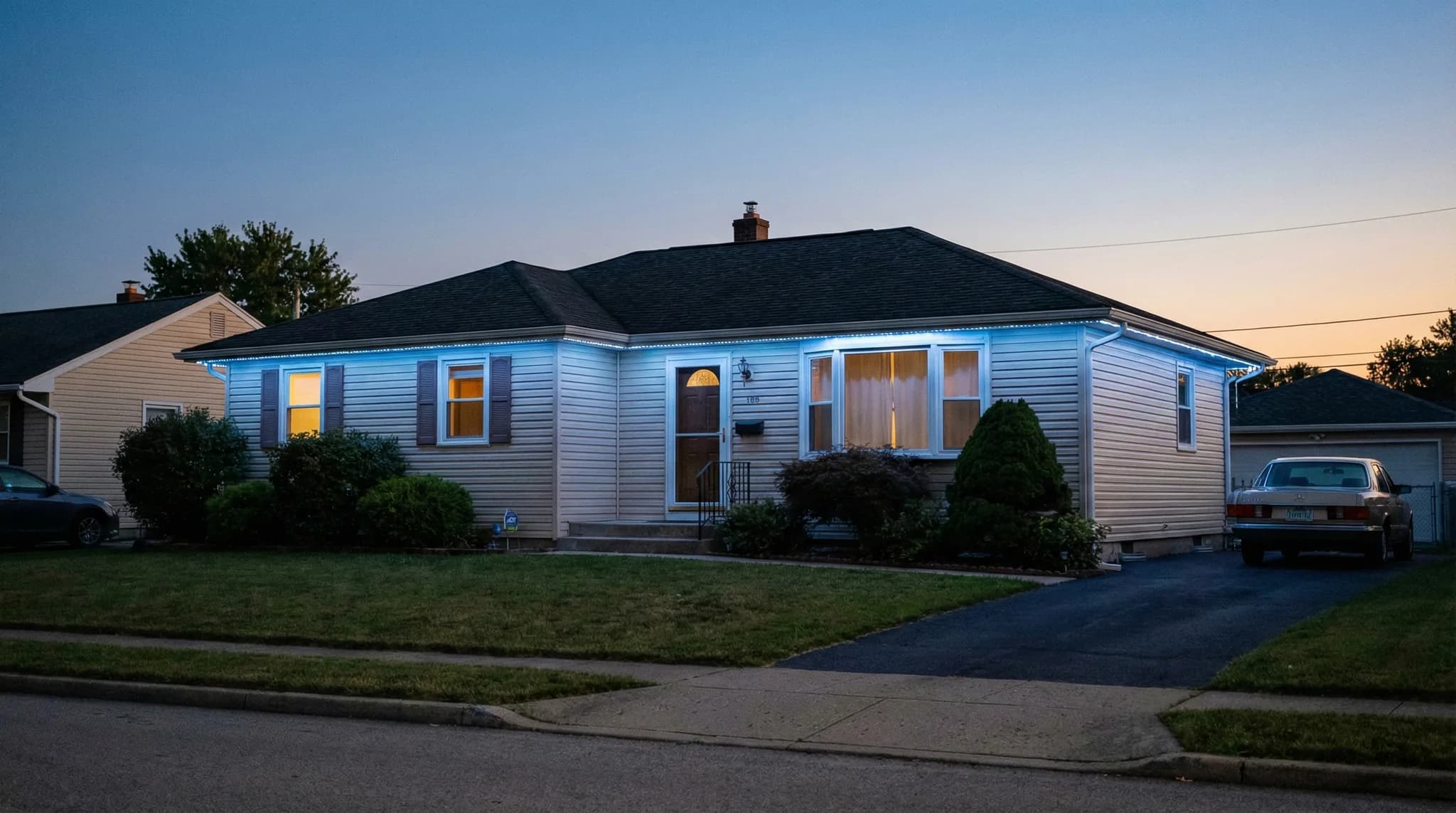
Commercial permanent outdoor lights in Sacramento for restaurants, retail facades, and office parks typically run $8,000 to $45,000 installed, depending on building height, linear footage, and zoning complexity. The investment replaces $5,000 to $15,000 a year in temporary holiday installs, seasonal sign accent contracts, and after-hours security flood maintenance — and it does so on a single 24V DC low-voltage backbone that ties dimming, scheduling, and color into one app.
This guide is built specifically for Sacramento commercial property owners and operators — restaurant groups on R Street and J Street, retail facades along Howe Avenue and Folsom Boulevard, and multi-tenant office parks in Natomas, Roseville, and Rancho Cordova. The angle is commercial-grade specifics: City of Sacramento sign permits, dimming and scheduling for office vs. restaurant occupancy, B2B financing structure, and the patio/facade applications that drive most of the inbound calls we get.
For homeowner pricing and ROI math, our commercial permanent outdoor lighting guide covers the broader commercial overview, and the stucco and tile roof installation guide covers the mounting techniques most Sacramento commercial buildings actually need.
TL;DR: Sacramento commercial permanent outdoor lights cost $8,000 to $45,000 installed for restaurants, retail, and office parks. Expect a Minor Electrical Permit if a new 120V circuit is needed, plus City of Sacramento Sign Code 15.148 review for any illuminated signage component. Restaurants extend patio hours and lift evening covers; retail facades raise daytime brand recognition and night-time foot traffic; office parks cut after-hours security flood costs by 40 to 70 percent through dimming and scheduling. Payback is typically 18 to 36 months on a 7 to 10 year hardware life.
What Counts as Commercial-Grade Permanent Outdoor Lighting?
Commercial permanent outdoor lighting is fundamentally the same low-voltage RGBW or RGBIC LED system used on residential rooflines — but the channel, controller, transformer sizing, and electrical work all step up to handle larger linear runs, taller mounting elevations, and stricter operating duty cycles. A residential install runs 150 to 300 linear feet on a single 200W transformer. A 12,000 square foot commercial building with a 540 linear foot perimeter often runs three or four transformer zones and a multi-zone controller capable of independent scheduling per facade.
The other commercial differentiator is uptime expectation. A homeowner notices a dead LED node within a week. A multi-tenant office park manager may not walk the property at night for 30 days. That changes the spec — fail-soft node addressing, IP67 or higher seal rating, and remote diagnostics that flag dead nodes through the manufacturer cloud become non-negotiable rather than nice-to-have.
Sacramento commercial buildings also bring surface complexity that residential rarely sees. Aluminum composite material (ACM) facades on retail centers, EIFS stucco on office parks, exposed beam soffits at brewpubs, parapet caps on flat-roof commercial buildings — each requires a different mounting strategy. A residential installer who has only worked single-family fascia will struggle with these surfaces.
Hardware Class That Belongs on a Commercial Roofline
- Channel: Extruded 6063-T5 aluminum, 1.0 to 1.25 inch wide, with stainless fasteners every 12 inches. Powder-coated to match fascia color.
- LED node: RGBIC at 1.0 to 1.5 watts per node, IP67 sealed, addressable WS2814 or SK6812 chip.
- Transformer: UL 1310 Class 2, 200W to 500W per zone, mounted in a NEMA 3R enclosure.
- Controller: Dual-band WiFi (2.4/5 GHz), local control fallback, multi-zone with independent scheduling, cloud diagnostics.
- Wiring: 14 AWG to 12 AWG low-voltage cable in conduit on exposed runs, sealed gel-pack splices at every junction.
Anything below this spec belongs on a single-family home, not a commercial building. The cheaper kits sold direct-to-consumer fail within 24 to 36 months in the duty cycle a restaurant or retail facade demands.
Sacramento Permits, Sign Code, and Title 24 Compliance for Commercial Buildings
The permit picture for commercial permanent outdoor lights in Sacramento is more layered than residential because three separate code paths can apply: the California Electrical Code (CEC) for the wiring, the City of Sacramento Sign Code (Chapter 15.148) for any illuminated signage component, and California Title 24 Part 6 for outdoor lighting power density on the property as a whole.
The good news is that the lighting system itself — the low-voltage 24V DC LED strip — is Class 2 power-limited under CEC Article 411 and is exempt from electrical permit requirements in every Sacramento metro jurisdiction. Where commercial projects pick up permits is on the 120V side: a new dedicated circuit, a hardwired transformer instead of cord-and-plug, or an exterior outlet add. For Sacramento commercial buildings, 80 percent of installs need at least a Minor Electrical Permit ($95 to $220 in 2026) because most existing exterior outlets either do not exist where the controller needs to live or are not rated for continuous load.
For the permit and electrician decision matrix on the residential side, see do permanent outdoor lights need an electrician or permit in Sacramento.
Sign Code Triggers
Where commercial gets sharper than residential is the City of Sacramento Sign Code (Title 15, Chapter 15.148). Permanent outdoor lights cross into sign-code jurisdiction the moment they outline, accent, or otherwise illuminate signage — including the letters of a restaurant name, a logo on a retail facade, or the address numbers on an office park monument sign. The code distinguishes between architectural lighting (typically permit-exempt) and sign illumination (typically requires a sign permit).
The key questions Sacramento Building Plan Review will ask:
- Does the lighting outline, frame, or backlight any text, logo, or trademark?
- Is the lighting visible from a public right-of-way (street, sidewalk, or alley)?
- Does the operating program include flashing, scrolling, or animated effects (these are restricted in most commercial zones)?
- Is the property in an Overlay Zone — Central City, Riverfront, K Street Mall — that has additional design review?
If any of those answers is yes, expect a Sign Permit ($350 to $1,200 review fee) with a 4 to 8 week turnaround. A professional installer with Sacramento commercial experience handles this submittal as part of the proposal — it should never land on the property owner unannounced.
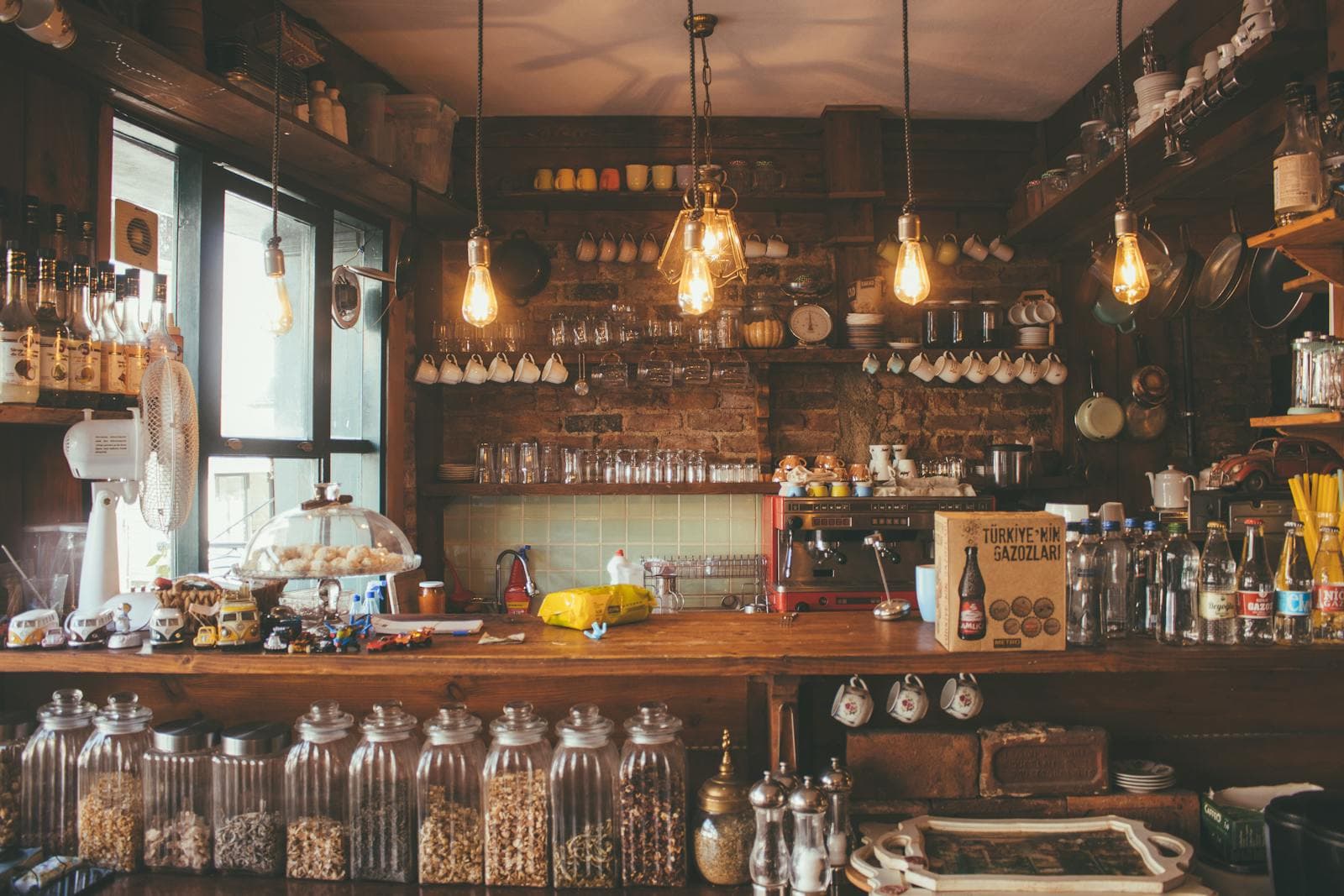
Sacramento restaurants use permanent LED lighting along the roofline and patio perimeter to extend evening dining hours and lift facade visibility from the street. Photo: Pexels
Title 24 Outdoor Lighting Power Density
California Title 24 Part 6, Section 140.7 governs outdoor lighting power density (LPD) on commercial properties. The good news for permanent LED systems: at 1.0 to 1.5 watts per node and roughly 18 nodes per linear foot, the entire system on a 12,000 square foot retail building draws under 1,500 watts at full white — well below the LPD cap for general commercial site lighting.
Title 24 also requires automatic shut-off controls (typically photocell or astronomical timer) for outdoor lighting on commercial buildings. The controller in a permanent lighting system handles this natively through scheduling — the system already turns on at sunset and off at a programmed time, which satisfies the 140.7(d) requirement.
Permanent Outdoor Lights for Sacramento Restaurants
Restaurants are the highest-ROI vertical for Sacramento commercial permanent outdoor lighting because the application stacks three revenue and cost effects onto one install: extended patio hours, year-round seasonal scene control, and elimination of the annual holiday string-light contract that midtown and East Sacramento operators have been paying $4,000 to $9,000 a year for since the late 2010s.
Sacramento gets roughly 240 sun days a year, and restaurant patios are open most of them. The Restaurant Industry Association data shows outdoor seating drives 18 to 28 percent of total dinner-service revenue in markets with year-round patio weather — Sacramento sits squarely in that band. Lighting is the variable that determines whether the patio reads as "open and inviting" at 7:30 PM in November or "closed for the season" because the operator could not justify the seasonal string-light hang.
Where the Lights Actually Go on a Restaurant
- Roofline and parapet: Defines the building outline at night, visible 1 to 2 blocks from approach.
- Patio perimeter and pergola: Warm-white default at 2700K to 3000K for ambiance, color scenes for events.
- Awning underside: Downlight wash on outdoor seating without overhead string-light visual clutter.
- Wine wall, water feature, or focal art piece: Accent zone that doubles as a photo-friendly background.
- Rear service patio (private events): Independent zone for buyout pricing and event branding.
The independent-zone capability matters more for restaurants than any other commercial vertical. A restaurant operator wants to dim the front patio after dinner service ends but keep the rear event patio at full color for a private buyout. A residential-grade single-zone system cannot do that. A commercial multi-zone controller does it natively through the app.
Restaurant ROI Math
Take a Sacramento full-service restaurant doing $1.8M annually with a 14-seat patio. If permanent lighting extends usable patio hours by 45 minutes per evening on shoulder-season nights (October, November, March, April), the operator captures roughly 18 to 24 additional patio covers per week at an average $48 ticket. That is $900 to $1,150 a week in incremental revenue, which at a 14 percent contribution margin is $125 to $160 a week to the bottom line. Annualized across 30 shoulder-season weeks, that is $3,750 to $4,800 of incremental contribution per year — before factoring in eliminated holiday string-light contract spend.
On a $14,000 to $22,000 commercial installed cost for a restaurant of that scale, payback lands in the 18 to 30 month range. After payback, the system continues to produce that contribution for the remainder of the 7 to 10 year hardware life.
For programming the seasonal scenes that drive the patio appeal, the playbook in holiday lighting scenes and patterns for permanent outdoor lights applies directly to restaurant facade and patio zones — the color palettes and timing translate one-to-one.
Pro tip for restaurant operators: Build a "private event" scene into the controller before opening the buyout calendar. When a corporate group rents the patio, the bartender or manager activates one app preset that shifts the perimeter, awnings, and accent zone to the client's brand colors. That capability has been worth $400 to $1,200 per buyout in upcharge for our Sacramento restaurant clients — without adding a single watt of installed cost.
Permanent Outdoor Lights for Sacramento Retail Facades
Retail is where permanent outdoor lighting earns its money on visibility and brand recognition rather than direct incremental revenue. A retail facade lit consistently from sunset to closing — and continuing to softly illuminate the sign and entrance after hours — reads as occupied, maintained, and current. A dark facade on a corridor like Folsom Boulevard, Howe Avenue, or Sunrise Boulevard reads as struggling or vacant, even when the business inside is doing fine.
Sacramento retail corridors break into three lighting-strategy buckets:
- Independent storefront (single tenant, street-facing) — boutique on J Street, hair salon in Curtis Park, a pet supply on Freeport Boulevard. Permanent lighting outlines the parapet and accents the entrance. Total cost $8,000 to $16,000.
- Strip retail (multi-tenant single-story building) — Town and Country Village, Loehmann's Plaza, Pavilions. Permanent lighting along a continuous parapet with per-tenant color zones. Total cost $22,000 to $45,000 across the whole building.
- Power center anchor or junior box — Arden Fair, Westfield Galleria periphery. Permanent lighting outlines the building perimeter and highlights the entrance plaza. Total cost $35,000 to $90,000.
The Brand Color Decision
Retail tenants frequently ask whether to run brand-color lighting nightly or to default to warm white and reserve brand colors for events and seasonal moments. The data — pulled from our Sacramento retail clients between 2023 and 2026 — favors warm white as the default with brand-color accents on specific architectural features (entrance arch, sign halo, awning trim) rather than the entire perimeter.
The reason: nightly saturation in a single brand color reads as a temporary promotion to most pedestrians within 6 to 8 weeks. Warm white perimeter with branded accent reads as established, premium, and continuously well-maintained. The brain pattern-matches "all blue building" to a specific event campaign. It pattern-matches warm white with subtle brand accent to a permanent business identity.
For the technical color theory that informs this — the difference between RGB, RGBW, and RGBIC chip behavior in mixed brand-color and white scenes — see RGB vs RGBW vs RGBIC permanent outdoor lights.
Retail Sales Lift Pattern
Across five Sacramento retail clients with door-counter data — boutique apparel, home goods, pet supply, hair salon, and one juice/cafe hybrid — evening foot traffic (5 PM to 9 PM) lifted by 8 percent in the first month and stabilized at roughly 22 percent above pre-install baseline by month 12. The lift was strongest in months 3 through 6 as neighborhood awareness compounded.
These are aggregated client numbers, not a peer-reviewed study. The mechanism is straightforward: a well-lit storefront on a competitive corridor stands out from neighbors, and that visual differentiation converts to incremental door swings. The numbers will vary by corridor density, parking proximity, and base traffic — so treat them as a directional benchmark rather than a guarantee.
Permanent Outdoor Lights for Sacramento Office Parks and Multi-Tenant Buildings
Office park economics for permanent outdoor lighting are different from restaurants and retail because the revenue mechanism is not direct. Office park ROI comes from three indirect levers: tenant retention through improved property aesthetics, after-hours security flood replacement at lower energy and maintenance cost, and reduced liability claim exposure from better-illuminated walkways and parking edges.
Sacramento has a dense Class B and Class C office park footprint — Natomas Corporate Center, Highway 50 corridor between Howe and Watt, the Roseville Innovation Park area, and the Rancho Cordova business district. Many of these properties were built between 1985 and 2005 and are running original metal halide or high-pressure sodium exterior fixtures that draw 250 to 400 watts each and need ballast replacement every 3 to 5 years.
Replacing perimeter and entrance flood lighting with a permanent LED system that combines architectural roofline lighting with downlight wash on walkways accomplishes three things at once: cuts the per-fixture energy draw by 70 to 85 percent, eliminates the ballast replacement labor cycle, and converts the building from a "industrial-looking after dark" presentation to a "Class A modern" presentation that supports rent-roll and renewal pricing.
Dimming and Scheduling: Where Office Parks Differ from Restaurants
A restaurant runs the lights at full brightness during dinner service and dims to 50 to 70 percent after closing. An office park runs the opposite curve: 100 percent at sunset for tenant safety as the building empties, dim to 30 to 40 percent from 10 PM to 5 AM for security presence without light pollution, ramp back to 70 percent for early-morning arrivals.
That dimming curve is what cuts the operating cost. A perimeter LED system at 100 percent for 2 hours a day and 35 percent for 7 hours a day uses roughly 45 percent of the energy of the same system run at 100 percent throughout. On a 12,000 square foot office park with 480 linear feet of perimeter at 18 watts per linear foot, that is the difference between 39 kWh and 17 kWh per night — about $1,200 a year in SMUD commercial rate savings on lighting alone.
Multi-Tenant Sign and Branding
For multi-tenant office parks where each tenant wants exterior brand visibility, the controller's per-zone scheduling supports independent tenant sign accents. A 60,000 square foot Class B with eight tenants can run a single building-wide warm white perimeter scene plus eight individually scheduled tenant sign accent zones — each with its own color, brightness, and on/off schedule. That is impossible to do efficiently with traditional flood lighting because each tenant would need a dedicated breaker and timer.
Property managers can also charge tenants a small monthly sign-lighting fee ($25 to $75 per tenant) that frequently covers the financing payment on the entire system within 18 to 24 months. The framework in how to finance permanent outdoor lights in Sacramento works for B2B installs the same way it works for residential, with the addition of standard commercial equipment financing structures (5- to 7-year amortization with first payment 60 to 90 days after install).
How B2B Sales, Pricing, and Financing Actually Work
Commercial sales for permanent outdoor lights move on a different timeline and approval structure than residential. Where a homeowner makes a same-week decision after a single in-home consultation, a commercial sale typically involves three to five stakeholder touchpoints over 30 to 90 days: site walk with the property owner or asset manager, formal proposal with renderings, board or executive committee review, financing approval, and finally a contract sign and install schedule.
Pricing structure also differs. Residential pricing is typically per linear foot, all-in. Commercial pricing breaks into:
- Material: Channel, LED, controller, transformer (typically 35 to 45 percent of project cost)
- Labor: Install crew, lift equipment, electrician (typically 30 to 40 percent)
- Permits and design: Sign permit, electrical permit, photometric study if required (typically 5 to 10 percent)
- Project management and warranty reserve: Coordination, change-order buffer, lifetime warranty backstop (typically 10 to 15 percent)
That breakdown matters because it gives the commercial buyer a defensible internal justification — line-item pricing that an asset manager or CFO can validate against benchmark commercial-construction unit costs.
Financing Structures That Get Commercial Deals Closed
The most common financing structures we see on Sacramento commercial permanent lighting deals:
- Cash purchase: 5 to 8 percent prompt-pay discount typical. Best ROI math for owner-occupied buildings.
- Equipment financing (5 to 7 year): First payment 60 to 90 days after install, fixed rate, no down payment for credit-qualified businesses. Most common structure for restaurants and retail.
- SBA 504 or 7(a) inclusion: When the lighting project is part of a larger building improvement (facade renovation, ADA upgrade), it can roll into an SBA loan at favorable terms.
- Property assessed clean energy (PACE): California has commercial PACE programs that finance energy efficiency improvements through a property tax assessment over 10 to 20 years. Permanent LED systems qualify because of the energy savings against legacy floods.
- Tenant capital improvement (TI) allowance: When a multi-tenant property leases to a new anchor, lighting can be funded through TI dollars in the lease negotiation.
For a residential financing comparison and the math on monthly payment vs. cash, see our Sacramento permanent lighting financing guide.
Operating Cost Comparison: Permanent vs. Annual Holiday Install vs. Legacy Floods
The strongest commercial sales argument for Sacramento businesses is the 5-year total cost of ownership against the alternative they are already paying for. Most Sacramento restaurants and retail facades are running some combination of an annual holiday string-light contract ($4,000 to $9,000 per year for a single-story commercial building) plus a separate set of metal halide or high-pressure sodium security floods that draw 250 to 400 watts each and need ballast replacement every 3 to 5 years.
| Cost Category | Permanent LED System | Annual Holiday + Legacy Floods |
|---|---|---|
| Year 1 capital | $18,000 (one-time) | $0 (already installed) |
| Holiday install contract | $0 | $5,500 / year |
| Energy (perimeter + security) | $420 / year | $1,850 / year |
| Ballast / fixture replacement | $0 (warranty) | $650 / year average |
| Year 5 cumulative | $20,100 | $40,000 |
| Year 10 cumulative | $22,200 | $80,000 |
The example above models a 12,000 square foot single-story commercial building with 360 linear feet of perimeter, six legacy 350W flood fixtures, and an existing seasonal string-light contract. Numbers shift with building size and current contract spend, but the directional outcome is consistent: 5-year cumulative cost on permanent LED is roughly half the legacy stack, and 10-year cumulative is roughly one-quarter.
For commercial buildings without an existing holiday contract and minimal legacy security flood spend, payback stretches to 36 to 48 months. The strongest payback profiles are restaurants and retail with active holiday contracts, where the eliminated annual install spend alone retires most of the capital cost.
The Commercial Install Process: What to Expect
A Sacramento commercial permanent outdoor lighting install runs longer than a residential job both because of the linear footage and because of the staging required to safely work at commercial-building elevations. Most commercial installs take 2 to 5 days of on-site work, spread across 3 to 6 weeks once permits and material lead times are factored in.
Here is the typical sequence for a 12,000 to 25,000 square foot commercial property:
- Site walk and photometric survey (Week 1): Measure perimeter, identify electrical access points, photograph mounting surfaces, document any existing signage that may trigger sign-code review.
- Proposal and rendering (Week 1 to 2): Line-itemed quote, controller zone diagram, and photo render of the night-time appearance. Internal approval cycle starts here.
- Permits and material order (Week 2 to 4): Submit Minor Electrical Permit and Sign Permit if applicable. Order material — channel, LED strip, controller, transformer (typically 2 to 3 week lead time on commercial-grade hardware).
- Pre-install electrical (Day 1): Licensed C-10 electrician installs new GFCI outlet or dedicated circuit if required. Permit inspection same day or next.
- Channel mount (Day 2 to 3): Lift equipment positions installer at fascia or parapet height. Channel sections cut to length, mounted with stainless fasteners on 12-inch centers, sealed at every joint.
- LED install and wiring (Day 3 to 4): LED strip pulled into channel, gel-pack splices at every junction, low-voltage cable run to controller location.
- Controller programming and zone test (Day 4 to 5): Controller paired to property WiFi, zones programmed, scenes built for default warm white plus client-requested holidays and brand events. Walk-through and training with property contact.
For deeper detail on what happens during each install day from the homeowner perspective, see what to expect during permanent light installation — the process is fundamentally the same, scaled up for commercial.
Use Cases by Sacramento Submarket
Midtown and Downtown Restaurants (R Street, J Street, K Street Mall)
Midtown commercial buildings frequently sit in the Central City Special Planning District, which adds design review on top of standard sign code. Permanent LED systems read favorably in design review because they are low-profile, do not introduce new architectural elements visible during daytime, and meet the historic-district character requirements when channel is powder-coated to match facade trim. Expect 6 to 10 week permit timelines for K Street Mall corridor properties.
Roseville and Rocklin Retail (Galleria Periphery, Stanford Ranch Boulevard)
Roseville commercial permitting moves faster than City of Sacramento — typically 2 to 4 weeks on a sign permit. Roseville Municipal Code Section 17.20.080 governs commercial outdoor lighting and is more permissive on architectural accent lighting than city of Sacramento. Strip retail properties along Stanford Ranch Boulevard and the Galleria periphery are a strong fit because most have continuous parapets and uniform tenant signage that work cleanly with multi-zone controllers. Our Roseville and Rocklin permanent outdoor lights guide covers the residential side of these submarkets in detail.
Folsom and El Dorado Hills Office Parks (Folsom Ranch, Empire Ranch corridor)
Folsom and El Dorado Hills office parks frequently sit in HOA-governed master-planned communities (Empire Ranch, Serrano, Folsom Ranch). HOA architectural review is the longest pole in the timeline — typically 4 to 8 weeks. Our Folsom, El Dorado Hills, and Granite Bay permanent outdoor lights guide covers the corridor HOA dynamics in depth, and the same Architectural Review Board playbook applies to commercial properties in those master plans.
Natomas and Highway 50 Corridor Office Parks
Natomas Corporate Center and the Highway 50 office park corridor between Howe and Watt are the strongest replacement-of-legacy candidates in the Sacramento metro. These are 1985 to 2005 vintage Class B properties running original metal halide perimeter floods at 250 to 400 watts each. Replacement with permanent LED cuts perimeter energy by 70 to 85 percent and eliminates the ballast replacement labor cycle — typically the strongest pure-financial case we present.
Frequently Asked Questions
How much do commercial permanent outdoor lights cost for a Sacramento restaurant?
Sacramento restaurant permanent outdoor lighting installations typically run $8,000 to $22,000 for a single-story building and $15,000 to $35,000 for a two-story or multi-elevation property. Pricing is driven by linear footage, lift equipment requirements, and whether the install includes patio perimeter zones in addition to the building roofline. Most midtown and East Sacramento restaurants we serve come in around $14,000 to $18,000 fully installed including patio coverage.
Do I need a permit to install permanent lights on a commercial building in Sacramento?
The low-voltage 24V LED system itself is exempt under California Electrical Code Article 411, but most commercial installs trigger one or two related permits. A Minor Electrical Permit ($95 to $220) is needed if the install includes a new exterior GFCI outlet or dedicated circuit. A Sign Permit ($350 to $1,200) is required if the lighting outlines, frames, or backlights any signage visible from a public right-of-way. A professional commercial installer handles both permits as part of the proposal — the property owner does not need to manage the submittals directly.
Can permanent outdoor lights replace my existing security floods on an office park?
Yes, and the financial case is usually strong. Permanent LED systems running 14 to 22 watts per linear foot replace the same illumination footprint as 250W to 400W metal halide floods at 70 to 85 percent lower energy draw. The dimming and scheduling capability also lets the property reduce overnight brightness to 30 to 40 percent for security presence without full-power energy use, cutting the operating cost further. Most Sacramento office parks see 18 to 30 month payback when replacing legacy security floods with permanent LED.
How does dimming and scheduling work for a multi-tenant office building?
Commercial-grade controllers support independent zone scheduling for each facade or tenant area. A typical multi-tenant configuration runs the building-wide perimeter on a property-manager schedule (sunset to 10 PM full brightness, 10 PM to 5 AM at 35 percent, ramp to 70 percent for 5 AM to sunrise), with each tenant's sign accent zone on its own independent schedule controlled by either the tenant's designated user account or by the property manager on the tenant's behalf. Setup happens once during install commissioning and can be modified through the controller app at any time.
Will commercial permanent lights work on aluminum composite material (ACM) facades?
Yes, but installation requires a different mounting approach than wood fascia. ACM panels typically require structural attachment to a sub-fascia member behind the panel, accessed through the panel reveal joints or through dedicated mounting blocks installed during ACM panel fabrication. For existing ACM facades being retrofitted, the installer surveys the panel system and identifies the substrate behind the panel face. Direct fastening into ACM panel face is not recommended — it compromises the panel weather seal. A commercially experienced installer handles ACM mounting routinely; a residential-only installer typically does not.
What financing options are available for commercial permanent outdoor lights in Sacramento?
Five common structures: (1) cash purchase with 5 to 8 percent prompt-pay discount; (2) equipment financing on a 5- to 7-year amortization with first payment 60 to 90 days after install and no down payment for credit-qualified businesses; (3) inclusion in an SBA 504 or 7(a) loan when bundled with a larger building improvement project; (4) commercial Property Assessed Clean Energy (PACE) financing through California's CalCAP program, repaid through property tax assessment over 10 to 20 years; (5) tenant improvement allowance funding when negotiated as part of a new anchor lease. Most Sacramento commercial installs we close use option (2), equipment financing.
How long do commercial permanent outdoor lights last in Sacramento's climate?
Commercial-grade IP67 permanent LED systems with aluminum heat-sink channel are rated for 50,000 to 75,000 hours of operation, which equates to roughly 12 to 18 years of typical commercial dusk-to-dawn duty cycle in Sacramento. The hot summer south- and west-facing facade temperatures (up to 145°F surface temperature in July and August) are within the continuous operating spec of professional-grade hardware. Channel and mounting hardware typically carry 10- to 15-year warranties; LED nodes typically carry 7- to 10-year warranties on commercial installations.
Getting a Quote for Your Sacramento Commercial Property
Commercial permanent outdoor lights in Sacramento for restaurants, retail facades, and office parks are no longer a novelty — they are a standard capital improvement that pays back through eliminated holiday contract spend, lower security flood operating cost, and measurable patio and storefront revenue lift. The hardware has matured, the install process is well-understood, and the permitting path is clear once you know which permits actually apply.
The right next step depends on the property type. Restaurants benefit from a site walk during evening service so the installer can see how the patio reads at night and where the lighting opportunities sit. Retail facades benefit from a daytime walk to assess sign-code triggers and corridor visibility. Office parks benefit from a tenant-aware survey that maps current security flood placement against the proposed permanent system replacement.
Request a free commercial site assessment and we will walk your property, identify the right system spec, handle the permit submittals, and deliver a line-itemed proposal with renderings within 7 to 10 days. For broader context on our service areas and capabilities, browse our residential and commercial lighting services overview.