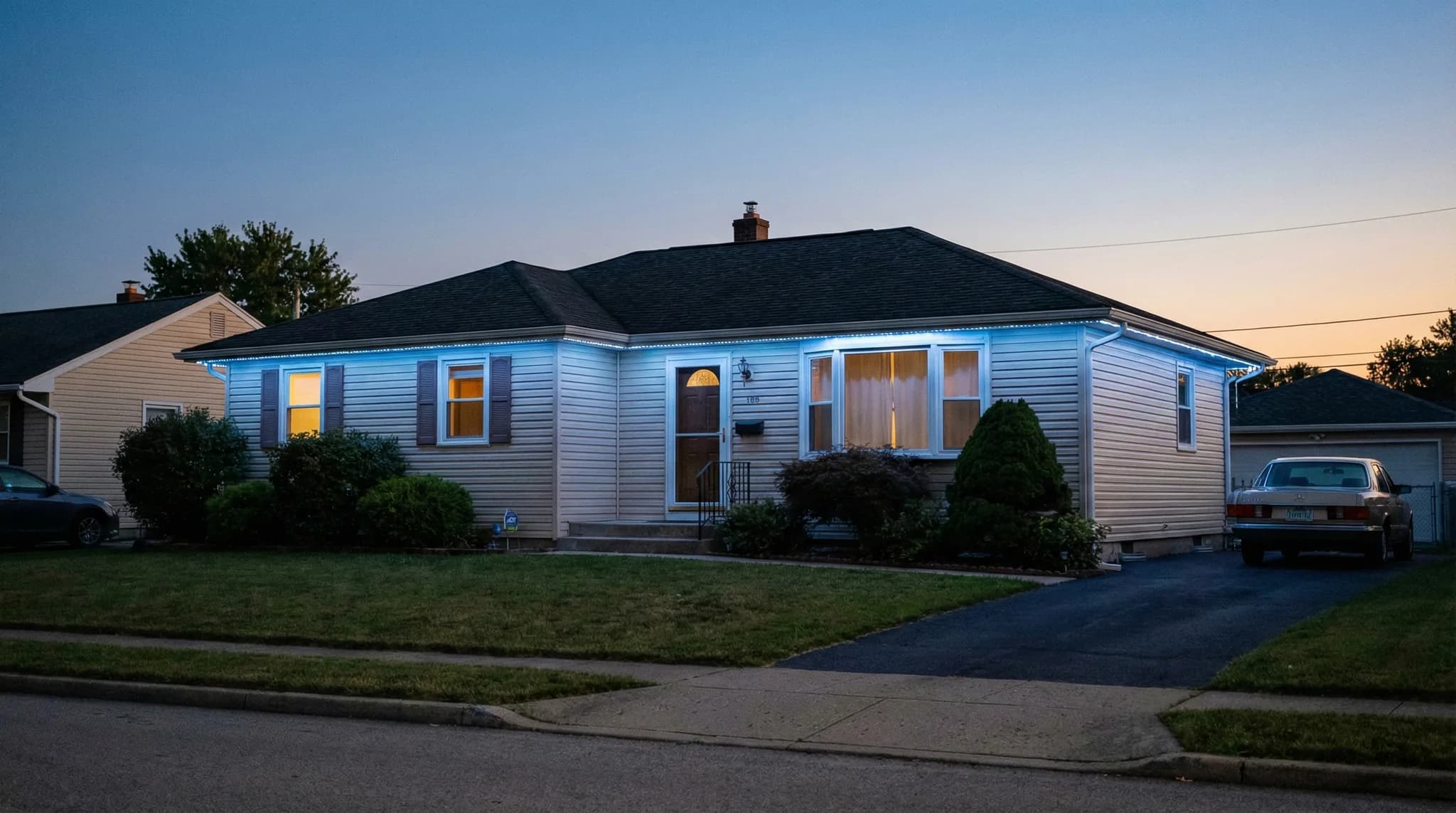
Most permanent outdoor lights installed on Sacramento homes do not require a licensed electrician or a city permit, because nearly every professional-grade system on the market is low-voltage (typically 24V DC) fed from a listed plug-in transformer on an existing GFCI-protected exterior outlet. Under California Electrical Code (CEC, Title 24 Part 3) Article 411 and the 2023 National Electrical Code, low-voltage landscape and decorative lighting is classified as a Class 2 power-limited system and is exempt from most of the permit and licensure rules that apply to 120V branch-circuit wiring. The answer changes the instant someone proposes running a new 120V circuit, adding a dedicated breaker, drilling through conditioned wall space, or tying into a line-voltage soffit fixture — at that point, Sacramento, Roseville, and Rocklin all require a permit and a C-10 licensed electrician.
This guide walks through exactly when you need an electrician, when you don't, what the Sacramento permit process looks like, what CEC Article 411 and NEC 2023 actually say about landscape lighting, and what the true cost difference is between a code-compliant low-voltage install and the electrician-plus-permit high-voltage route. The difference matters: pick the wrong path and you are either overpaying for unneeded licensed labor or creating an uninsured, unpermitted exterior circuit that shows up on a future home inspection.
TL;DR: Permanent outdoor lights in Sacramento generally do not require an electrician or a permit because reputable systems (EXT Lighting, Trimlight, Jellyfish, Gemstone) are 24V Class 2 low-voltage per CEC Article 411 — they plug into an existing exterior GFCI outlet, no branch-circuit work needed. You do need a permit and a C-10 licensed electrician if the install requires a new 120V outlet, a dedicated circuit, a new breaker, or any hardwired line-voltage fixture. Self-install risk is real: voiding the manufacturer warranty, failing home inspection, and triggering Title 24 compliance issues at sale. Expect roughly $0 to $200 in permit / electrician cost for typical low-voltage plug-in installs, versus $350 to $1,200+ if a new exterior outlet or dedicated circuit is required.
The Short Answer: Low-Voltage Systems Are Exempt from Most Electrician and Permit Requirements
Every reputable permanent outdoor lighting brand sold and installed in the Sacramento market — EXT Lighting, Trimlight, Jellyfish, Gemstone, Oelo, Everlights — ships a low-voltage system. The visible LED strip on your roofline is running on 24V DC (a few use 12V DC). The only part of the system that sees 120V household current is the transformer, and that transformer is a UL-listed, cord-and-plug device that simply plugs into a standard exterior GFCI outlet, usually in the garage or on the side of the house.
That single design choice is what pulls permanent LED lights out of the permit-and-electrician category. Under the 2023 National Electrical Code Article 411 (Low-Voltage Lighting) and the California Electrical Code adopted in Title 24 Part 3, systems operating at 30 volts or less (Class 2 power-limited) are governed by dramatically relaxed rules compared to 120V/240V branch-circuit wiring.
What “Class 2 Low-Voltage” Actually Means
NEC Article 725 and Article 411 define a Class 2 power-limited circuit as a circuit where the power supply (the transformer) is physically incapable of delivering enough energy to start a fire in typical installation conditions or to produce a meaningful electric shock through intact skin. Because of that inherent safety limit, Class 2 wiring:
- Does not require conduit (in most cases).
- Does not require the AWG wire sizes mandated for branch circuits.
- Does not require a permit from the Authority Having Jurisdiction (AHJ) in most California municipalities for plug-and-cord installations.
- Does not require a C-10 licensed electrician to install, so long as no 120V work is performed.
In plain English: a licensed low-voltage integrator, a lighting installation company, or a reasonably handy homeowner can install the 24V portion of the system legally in California, because the 24V wiring is not legally classified the same as house wiring.
Voltage Comparison: Why Low-Voltage Changes the Rules
For a deeper dive into the engineering and the practical tradeoffs between the two categories, see our low-voltage vs. high-voltage permanent outdoor lights comparison.
CEC Article 411, Title 24, and NEC 2023: What the Code Actually Requires
Three documents govern permanent outdoor lighting installation in Sacramento. Each one gets misread frequently, so here is what they actually say.
National Electrical Code 2023 — Article 411
Article 411 of the 2023 NEC is titled “Low-Voltage Lighting” and covers lighting systems operating at 30 volts or less. The key provisions relevant to Sacramento homeowners:
- 411.3 — Allows listed low-voltage lighting systems to be supplied from a listed Class 2 power supply (your transformer).
- 411.4 — Wet location luminaires must be listed for wet locations. Nearly every commercial permanent light on the Sacramento market carries an IP65 or IP66 wet-location listing.
- 411.5(B) — Secondary circuits may be installed as open conductors (no conduit required) if the circuit is Class 2 and installed per the manufacturer's instructions.
- 411.6 — Secondary circuits must not be installed within 10 feet of a pool, spa, or fountain unless specifically listed for that use.
California Electrical Code (Title 24, Part 3)
Title 24, Part 3 is California's adoption of the NEC with California-specific amendments. For low-voltage landscape and decorative lighting, California follows the federal NEC Article 411 and Article 725 almost verbatim. The Title 24 amendments mainly tighten energy-efficiency rules on line-voltage lighting (Title 24 Part 6), which do not apply to properly classified Class 2 decorative LED systems.
Sacramento, Roseville, and Rocklin Amendments
All three municipalities adopt the California Electrical Code by reference and enforce it through their Community Development and Building departments. None of the three currently requires a permit for a plug-and-cord low-voltage landscape or decorative lighting system installed per the manufacturer's listing. All three do require a permit and a C-10 license for:
- Installation of any new 120V or 240V circuit, outlet, or device.
- Modification of the main service panel or any sub-panel.
- Hardwiring any line-voltage luminaire, including hard-wiring a transformer that was designed for cord-and-plug connection.
- Installation of exterior outlets where none exists.
This matters in one specific and common case: older Sacramento homes (Curtis Park, Land Park, Tahoe Park, older sections of Carmichael and Fair Oaks) often lack a conveniently located exterior GFCI outlet. Adding one is 120V branch-circuit work and crosses the permit-and-licensure line.
Pro Tip
Before you book the permanent lighting install, walk to the likely transformer location (garage exterior wall, side yard, or soffit by the meter) and confirm there is a weather-rated GFCI outlet within 6 to 10 feet of where the channel will start. If there isn't, add a line item to your quote for a licensed electrician to install one. That is a 1 to 2 hour job, generally $250 to $500 in Sacramento, and it converts a permit-required add-on into a clean, permitted, code-compliant setup.
When You Need a Permit and a Licensed Electrician in Sacramento
The permit-and-electrician question has five common trigger points. If any of the following applies to your project, pull the permit and hire the C-10 up front.
Trigger 1: No Existing Exterior GFCI Outlet
The low-voltage transformer must be cord-and-plug connected to a GFCI-protected receptacle rated for wet or damp location (depending on where it lives). If your home has no exterior outlet within reach, installing one is 120V work. In the City of Sacramento, this requires a Minor Electrical Permit (the permit category covers most single-receptacle additions).
Trigger 2: Dedicated Circuit Required for Larger Systems
Very large homes — 350+ linear feet of roofline, two- and three-story Granite Bay or El Dorado Hills homes, or commercial properties — sometimes require a dedicated 15A or 20A circuit because the combined transformer load plus holiday decor plus existing exterior outlet load would exceed 80 percent of the circuit capacity (the NEC 80% continuous-load rule, Article 210.19). Adding a dedicated circuit is always permitted work and always requires a C-10.
Trigger 3: Hardwired Transformer (Line-Voltage Side)
A few integrators offer the option to hardwire the transformer directly into a junction box rather than using the standard cord-and-plug connection, typically for aesthetic reasons or because the homeowner wants the transformer indoors. Hardwiring the transformer crosses the line into permanent 120V wiring and requires a permit and a licensed electrician in Sacramento, Roseville, and Rocklin.
Trigger 4: Replacing or Tapping a 120V Soffit Fixture
Some older homes have line-voltage soffit or eave lights. If a homeowner or a non-licensed installer removes the existing line-voltage fixture and taps into the 120V wiring to power a transformer or an adapter, that is line-voltage branch circuit modification. It requires a permit and a C-10. Reputable integrators will not do this work themselves; they will subcontract it or reroute.
Trigger 5: Smart Home / Panel Integration
Integrating permanent lights with a smart panel (Span, Lumin, SPAN Drive), a whole-home automation system that touches breakers, or a generator/solar backup system is always permitted work and always requires licensed electrical labor. Most homeowners doing this already have an electrician on the project.
When You Don't Need a Permit or an Electrician
For the large majority of Sacramento homes, you need neither. The conditions:
- You already have a weather-rated GFCI exterior outlet near the planned transformer location.
- The system runs at 30V or less (every reputable permanent light brand on the market).
- The transformer is UL-listed and used as a cord-and-plug device as the manufacturer intended.
- The low-voltage strip and channel are installed per manufacturer specifications, not hardwired into anything.
- The installed system does not exceed 80 percent of the outlet circuit capacity when combined with other continuous loads.
For the typical 2,000 to 2,800 sq ft Sacramento single-family home with 150 to 220 linear feet of roofline, the combined transformer draw is usually 60 to 180 watts at 120V (about 0.5 to 1.5 amps on a 15 or 20 amp circuit). Plenty of headroom, and no new wiring required.
For the full end-to-end installation walkthrough, see our permanent light installation process guide.
The Sacramento Permit Process, If You Need One
Permits are handled by the Authority Having Jurisdiction for the property. In the four main service areas EXT Lighting works in:
- City of Sacramento – Community Development Department, Building Division. Minor electrical permits are handled online through the City of Sacramento Citizen Portal.
- Unincorporated Sacramento County – Sacramento County Building Permits Division, online permit portal.
- City of Roseville – Development Services Department, online eTRAKiT portal.
- City of Rocklin – Building Services, online permit portal.
For the common case — adding one exterior GFCI outlet so a low-voltage permanent lighting system can plug in — here is the typical flow.
Permit Flow: Adding an Exterior Outlet for a Low-Voltage System
The inspection timeline varies. City of Sacramento Minor Electrical Permits typically inspect within 5 to 15 business days of request. Roseville and Rocklin usually inspect within 3 to 10 business days. The permanent lighting install itself can be scheduled any time after inspection sign-off, but doesn't have to wait if the outlet is being added as a separate phase.
The Self-Install Risk: Voided Warranties, Failed Inspections
California does not prohibit a homeowner from installing a low-voltage lighting system on their own primary residence, provided they do not perform unpermitted 120V work. But there are four real risks that most DIY Sacramento homeowners underestimate.
Risk 1: Voided Manufacturer Warranty
Every major permanent lighting brand — EXT Lighting, Trimlight, Jellyfish, Gemstone, Oelo — requires factory- certified installation to keep the warranty active. EXT Lighting's lifetime warranty on parts and labor, for example, is contingent on professional installation by a certified installer. A DIY install with shop-purchased parts and a generic transformer is explicitly excluded. Replace the transformer or a damaged section out of pocket and it quickly eats any DIY cost savings.
Risk 2: Failed Home Inspection at Sale
California real estate home inspectors regularly flag any obvious DIY exterior electrical work — including extension cords running to unpermitted outlets, hardwired transformers without a visible permit card history, or damaged soffit penetrations. A failed inspection item can kill a deal or trigger a $1,500 to $5,000 repair credit at close.
Risk 3: Homeowner Insurance Exposure
If an unpermitted, non-code-compliant electrical install contributes to a fire or property damage event, the homeowner's insurance carrier has grounds to reduce or deny the claim. The payout risk on a $3,000 to $8,000 lighting system is not worth the $0 permit savings.
Risk 4: Fascia and Roof Damage
Separately from the electrical question, DIY installers routinely damage fascia and underlayment with improper fastener choice, inadequate sealing, and bad spacing. The repair cost to rebuild a damaged section of fascia typically runs $800 to $2,500 — multiples of what a professional permanent lighting install would have cost. For the pricing picture, see our Sacramento permanent outdoor lights cost guide.
Cost Difference: With vs. Without Electrician
Here is the honest cost picture for a typical 2,000 to 2,800 sq ft Sacramento single-family home (roughly 150 to 220 linear feet of roofline) in four common scenarios.
Three practical takeaways from the math:
- Hiring an electrician when you don't need one (adding $450+ in C-10 labor to a plug-in install on an existing outlet) is pure overhead. A reputable permanent lighting installer handles the low-voltage work directly and will tell you honestly whether you need a C-10 at all.
- Skipping the electrician when you do need one (DIY outlet add, hardwired transformer) voids the warranty, risks insurance denial, and creates a permit liability at future home sale — the $450 is cheap insurance.
- The DIY route looks cheaper on paper ($3,800 parts-only estimate), but one warranty claim, one fascia rebuild, or one failed home inspection wipes out the savings. Most DIY systems also don't deliver the visual result of a professional install.
For a broader perspective on Sacramento's holiday and permanent lighting market, see Holiday Lights Without a Ladder, which breaks down why so many Sacramento homeowners are moving off the ladder-and-strand routine entirely.
Pro Tip
Ask your installer specifically: “What voltage is the system, and does the transformer plug into a standard GFCI outlet?” If the answer is 24V (or 12V) and cord-and-plug, you are in Class 2 / Article 411 territory and almost certainly do not need a permit or a C-10. If the answer involves anything hardwired or any new 120V circuitry, ask who is pulling the permit and whether the C-10 license is theirs or a subcontractor's. Get the permit number in writing.
What Sacramento Homeowners Should Actually Do
A practical decision sequence:
- Walk your fascia. Identify where the transformer will live. Confirm an exterior GFCI outlet is within reach, weather-rated, and on a circuit that isn't already close to capacity.
- Confirm the system voltage. Get the spec sheet from the installer. Reputable brands clearly state 24V or 12V Class 2.
- Verify the installer's licensing and insurance. California requires a C-10 for 120V work and a general contractor (B) or a specialty low-voltage license (C-7 Low-Voltage Systems) for large installations. Many reputable permanent lighting companies operate under a C-7 or a specialty lighting license plus a licensed GC, with a C-10 subcontractor used only for actual line-voltage work.
- Ask whether any line-voltage work is required. If the answer is yes, ask for the permit number and the C-10 license number for the electrician doing that portion.
- Keep the paperwork. Save the warranty registration, the permit card (if applicable), and the installer's license number. These all come up at future home sale.
Get a free Sacramento quote
EXT Lighting installs low-voltage Class 2 permanent outdoor lights across Sacramento, Roseville, Rocklin, Folsom, and El Dorado Hills. We handle the lift, coordinate any C-10 electrical work needed on your outlet or circuit, and carry a lifetime warranty on parts and labor. We'll tell you up front whether your home needs a permit or not.
Request a Free QuoteFrequently Asked Questions
Do permanent outdoor lights require an electrician?
For the typical Sacramento single-family home with an existing exterior GFCI outlet, no. Reputable permanent outdoor light systems are 24V DC Class 2 low-voltage per NEC Article 411 and California Electrical Code (Title 24, Part 3), which means the low-voltage portion can be installed by a certified lighting integrator without a C-10 licensed electrician. You only need a C-10 if the install requires new 120V branch-circuit work — a new outlet, a dedicated circuit, a hardwired transformer, or panel work.
Do I need a permit for permanent outdoor lights in Sacramento?
Not for the low-voltage lighting system itself. The City of Sacramento, Sacramento County, Roseville, and Rocklin all follow the California Electrical Code, which exempts Class 2 plug-and-cord low-voltage landscape and decorative lighting from permit requirements. A permit is required if any 120V work is performed as part of the install — adding an exterior GFCI outlet, running a dedicated circuit, or hardwiring a transformer. For those specific add-ons, a Minor Electrical Permit (typically $85 to $180 fee) is pulled by the licensed electrician doing the line-voltage work.
Are permanent outdoor lights low voltage?
Yes. Every reputable permanent outdoor lighting brand on the Sacramento market — EXT Lighting, Trimlight, Jellyfish, Gemstone, Oelo, Everlights — uses 24V DC (a few use 12V DC) low-voltage LED strips. The transformer steps 120V household power down to 24V and is itself UL-listed and cord-and-plug connected to a standard exterior GFCI outlet. The entire visible lighting system — the channel, the LED strip, the cabling to the controller — operates at 30V or less, well within Class 2 power-limited territory.
Can I install permanent outdoor lights myself in Sacramento?
Legally, yes, a California homeowner can install low-voltage lighting on their own primary residence without a license, as long as no unpermitted 120V work is performed. Practically, DIY installation voids every major brand's warranty, creates fascia-damage and weatherproofing risk, and frequently fails to deliver the clean visual result of a professional install. The cost savings ($3,800 DIY vs. $4,900 professional for a typical Sacramento home) are usually erased by one warranty claim or one fascia repair.
What is the cost difference with vs. without an electrician?
For a typical 2,000 to 2,800 sq ft Sacramento single-family home, the total installed cost runs around $4,900 for a plug-in-to-existing-outlet system with no electrician involvement, roughly $5,350 if a new exterior GFCI outlet needs to be added (add $350 to $500 for the C-10 plus $85 to $180 for the Minor Electrical Permit), and around $6,100 if a dedicated circuit back to the panel is required. The electrician/permit delta is generally $450 to $1,200 depending on scope — meaningful, but small as a percentage of the total project.
Does California Title 24 apply to permanent outdoor lights?
Title 24 Part 3 (the California Electrical Code) applies and governs the voltage classification — reputable 24V systems qualify as Class 2 and are exempt from most permit/licensure requirements. Title 24 Part 6 (California Energy Code) regulates lighting power density and efficacy for indoor and outdoor line-voltage lighting, but low-voltage decorative LED systems fall outside its primary scope because they are classified as decorative rather than general outdoor lighting. Your permanent lighting installer should still confirm compliance for any unique circumstances (e.g., a commercial property under a Title 24 Part 6 energy budget).