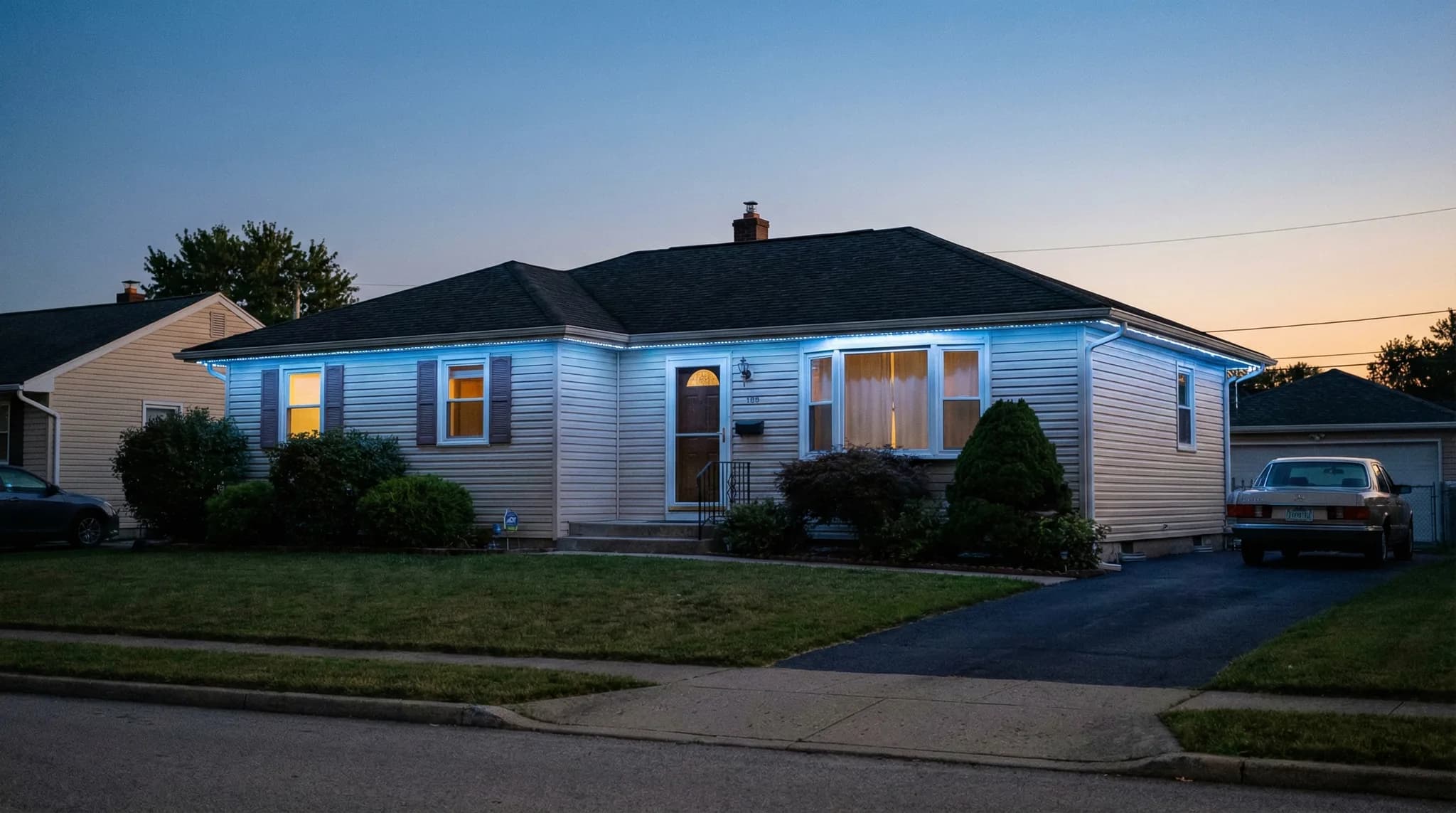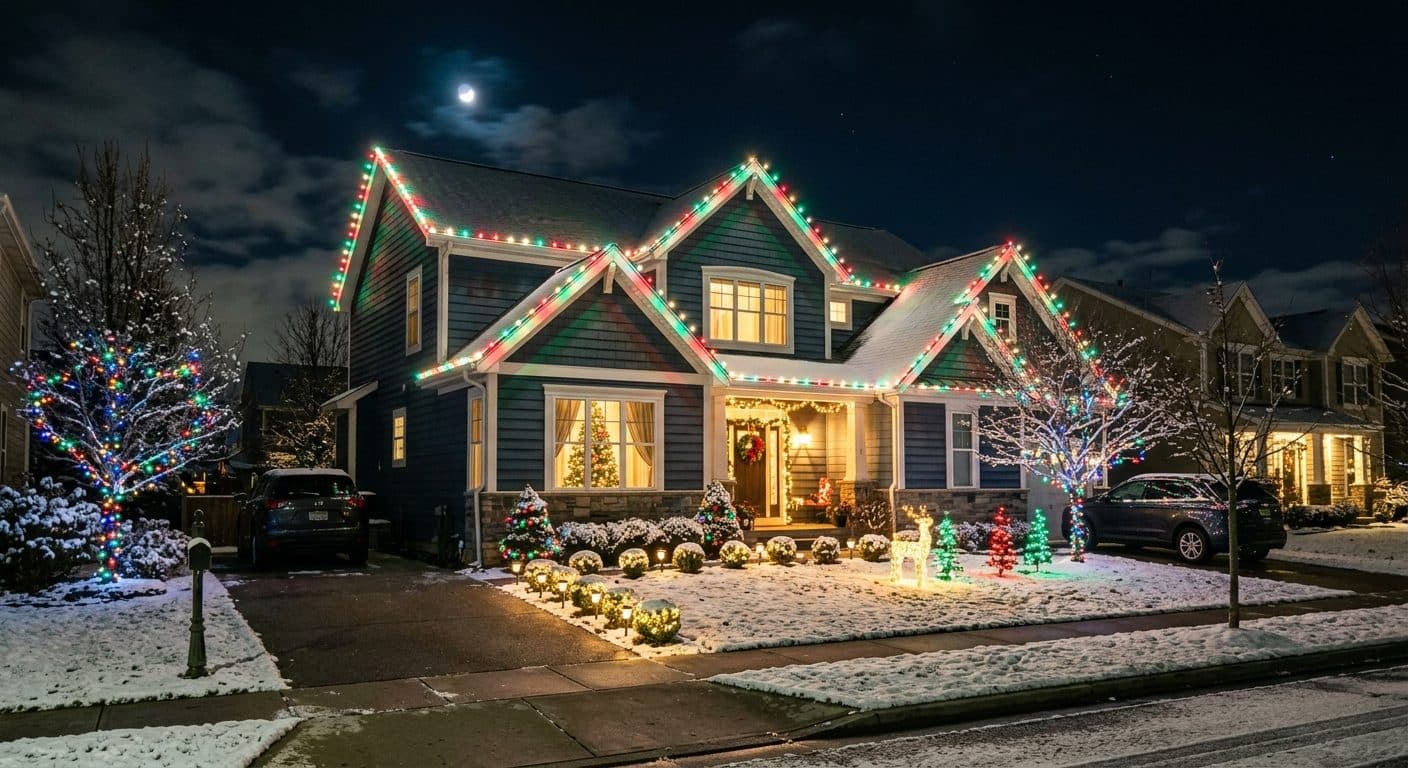
Permanent holiday lighting turns the same roofline track into Christmas red-and-green in December, warm white the rest of the year – all from an app.
Permanent holiday lighting in Sacramento replaces the annual ritual of climbing ladders, untangling strings, and hiring a crew every December. Instead, a single set of professionally installed LED nodes runs along your roofline year-round, and you switch it from everyday warm white to full Christmas red-and-green – or any of millions of colors – from your phone in seconds.
That is the core appeal: one install, every holiday covered. Christmas, Halloween, the Fourth of July, Diwali, game days, and Valentine's all run off the same hardware. No storage bins, no take-down in January, no $500–$1,500 seasonal install bill year after year.
This guide explains how permanent holiday lighting works, how it compares to traditional seasonal installs on cost and convenience, what programmable holiday scenes can actually do, and what Sacramento homeowners should know before buying. If you are weighing the overall investment first, start with our permanent lights ROI analysis.
TL;DR: Permanent holiday lighting is a year-round LED system, professionally mounted along your roofline, that you control by app. For the holidays you trigger preset scenes – Christmas red-and-green, Halloween orange-and-purple, July 4th red-white-and-blue – without ever touching a ladder. A Sacramento install runs roughly $3,000–$8,000 one time, versus $500–$1,500 every year for temporary holiday light service. The lights use modern LEDs that draw about $2–$8 per month and, per the U.S. Department of Energy, use at least 75% less energy than incandescent holiday strings.
What Is Permanent Holiday Lighting?
Permanent holiday lighting (also called permanent Christmas lights or permanent outdoor lights) is a system of individually addressable RGB or RGBW LED nodes set inside a low-profile aluminum channel that mounts under your roofline, eaves, or fascia. The track is color-matched to your trim, so during the day it nearly disappears. At night, the LEDs do whatever your app tells them to.
The “holiday” part is software, not hardware. The exact same nodes that glow soft warm white in October become Halloween orange and purple on the 31st, then Christmas red and green in December, then warm white again in January – all without anyone setting foot on a ladder. For a deeper technical walkthrough, see how permanent Christmas lights work.
Year-Round vs. Seasonal: The Key Difference
Traditional holiday lights are seasonal by definition – they go up in November and come down in January, then sit in a box for ten months. Permanent holiday lighting is the opposite: it lives on your house all year and simply changes job description by season. That single shift is what eliminates the recurring cost and labor.
Pro Tip
Schedule your holiday scenes in advance. Most app-controlled systems let you set Christmas red-and-green to auto-activate on December 1 and revert to warm white on January 2 – so your “holiday install” happens automatically while you do nothing. See our year-round scheduling guide for a month-by-month calendar.
How Much Does Permanent Holiday Lighting Cost vs. Seasonal Installs?
The honest comparison is one-time cost versus recurring cost. Permanent holiday lighting is a larger upfront investment, but it is paid once. Temporary holiday light service is cheaper per year but never stops – you pay it again every single December for as long as you want lights.
| Cost Factor | Seasonal Holiday Install | Permanent Holiday Lighting |
|---|---|---|
| Upfront cost | $0 (service-based) | $3,000–$8,000 one time |
| Annual recurring cost | $500–$1,500 every year | $0 (own the system) |
| Install & takedown labor | Twice a year, scheduled | None – app only |
| Other holidays covered | Christmas only (typically) | Every holiday + everyday |
| 5-year total (est.) | $2,500–$7,500 | $3,000–$8,000 (then flat) |
Seasonal service estimates based on typical Sacramento-area holiday light installation pricing. Permanent system pricing reflects residential installs; energy cost not included (see our electricity guide).
The crossover point usually lands in years 3 to 5. After that, the permanent system keeps working for free while the seasonal bill keeps coming. And the table understates the permanent system's value, because it also delivers everyday curb appeal and every other holiday at no extra cost. For a full breakdown, see our permanent vs. Christmas lights comparison and the Sacramento pricing guide.
Programmable Holiday Scenes: What Can They Actually Do?
The feature that sells most Sacramento homeowners is the scene library. Because each LED node is individually addressable, the system can run patterns – not just static colors. Through the manufacturer app you get presets for every major holiday plus the ability to build your own.
- Christmas: static red-and-green, alternating candy-cane, twinkling warm white, or animated chase patterns
- Halloween: orange-and-purple, flickering “flame” effects, or eerie color fades
- Fourth of July: red-white-and-blue with optional animated “fireworks” sequences
- Thanksgiving: warm amber and deep orange tones
- Diwali: warm gold and saturated jewel tones
- Game day: your team's colors in seconds
- Everyday: a single, tasteful warm white that reads as architectural lighting, not holiday lights
Many systems also offer music sync, so a Christmas display can pulse to the beat of a playlist. For specific holiday programming ideas, see our holiday lighting patterns guide and our breakdown of Diwali, Halloween, and July 4th displays.
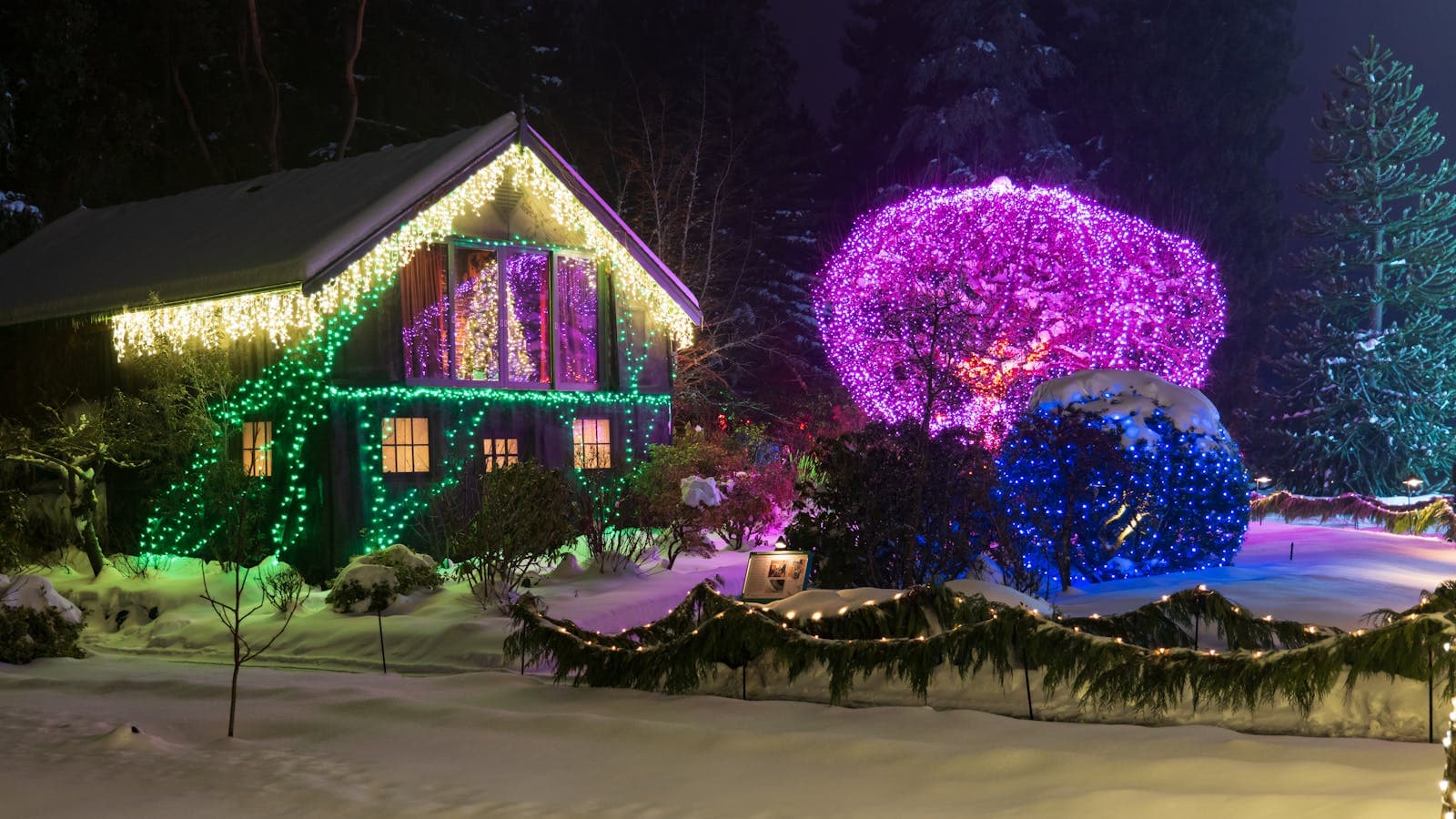
No ladder, no tangled strings – holiday scenes change from the app, even from inside the house.
Why Year-Round Beats Seasonal-Only Holiday Lights
A common misconception is that permanent holiday lighting is “just Christmas lights you leave up.” It is not. Because the everyday mode is a clean warm white, the system functions as architectural accent lighting for the other eleven months. That delivers value a seasonal-only install never can.
- Curb appeal every night: warm white roofline lighting improves a home's presence after dark all year, which matters for both daily enjoyment and selling faster.
- Security: a consistently lit exterior signals occupancy and deters opportunistic crime – see our outdoor lights and security guide.
- Zero seasonal labor: the holidays “install themselves” on a schedule you set once.
- One system, every occasion: birthdays, graduations, and watch parties all get custom color with no extra spend.
Energy Use: Are Year-Round Holiday Lights Expensive to Run?
No. This is where modern LEDs change the math. Old incandescent holiday strings were genuinely power-hungry, which is part of why people only ran them for a few weeks. Permanent systems use addressable LEDs that sip power.
According to the U.S. Department of Energy, LED lighting uses at least 75% less energy than incandescent lighting and lasts up to 25 times longer. The ENERGY STAR program notes that widespread LED adoption avoids large amounts of energy use nationally for exactly this reason.
| Metric | Incandescent Holiday Strings | Permanent LED System |
|---|---|---|
| Whole-home wattage | 400–800W | 60–120W |
| Energy use vs. incandescent | Baseline | 75%+ less (per DOE) |
| Monthly cost to run | $9–$18 (6 hrs/day) | $2–$8 |
| Practical run window | Holidays only | Year-round |
Energy reduction figure per U.S. Department of Energy. Sacramento monthly cost estimates based on SMUD residential rates; see our electricity cost guide for the full calculation.
The takeaway: running tasteful holiday lighting every night of the year on a permanent LED system costs less per month than running old-style incandescent strings did for six weeks. Our electricity cost guide runs the SMUD-rate math in detail.
Done Climbing Ladders Every December?
We design permanent holiday lighting for Sacramento homes – one install, every holiday handled from your phone. Free, no-obligation consultation.
Get Your Free QuoteWhat Sacramento Homeowners Should Know Before Buying
Sacramento's climate – long, hot, UV-intense summers – rewards a few specific choices. Prioritize an IP67-or-higher weather rating and mechanical (screw or clip) mounting rather than adhesive, which degrades in sustained 100°F+ heat. For the full vetting checklist, see our how to choose permanent outdoor lights guide.
If your neighborhood has an HOA, confirm that a static warm-white everyday mode satisfies architectural rules – most do, since warm white in the 2700K–3000K range reads as standard exterior lighting. Our HOA rules guide covers how to present the system for approval.
Frequently Asked Questions About Permanent Holiday Lighting
What is permanent holiday lighting?
Permanent holiday lighting is a year-round LED system mounted along your roofline that you control with a smartphone app. The same fixtures display Christmas red-and-green in December, Halloween orange-and-purple in October, and tasteful warm white the rest of the year – with no annual install or take-down.
Can permanent lights do Christmas red and green?
Yes. Permanent RGB and RGBW systems produce millions of colors, including classic Christmas red-and-green. You can run them static, in alternating candy-cane patterns, or in animated chase sequences, and switch the whole display from the app in seconds.
Do you leave permanent holiday lights up all year?
Yes, that is the point. The track is color-matched to your trim and nearly invisible during the day, and the everyday mode is a clean warm white that functions as architectural accent lighting. You only switch to holiday colors when you want them.
How much does permanent holiday lighting cost in Sacramento?
A residential install typically runs $3,000 to $8,000 one time, depending on roofline length and complexity. That replaces $500 to $1,500 per year in temporary holiday light service, so most systems pay for themselves within three to five years while also covering every other holiday.
Are year-round holiday lights expensive to run?
No. Modern LED systems use at least 75% less energy than incandescent strings (per the U.S. Department of Energy), drawing roughly $2 to $8 per month on Sacramento SMUD rates even with daily use. Running them all year costs less per month than old incandescent lights did for six weeks.
One Install. Every Holiday. Zero Ladders.
EXT Lighting installs permanent holiday lighting across Sacramento, Roseville, Rocklin, Folsom, and surrounding areas – with a lifetime warranty on parts and labor.
Schedule Your Free Consultation