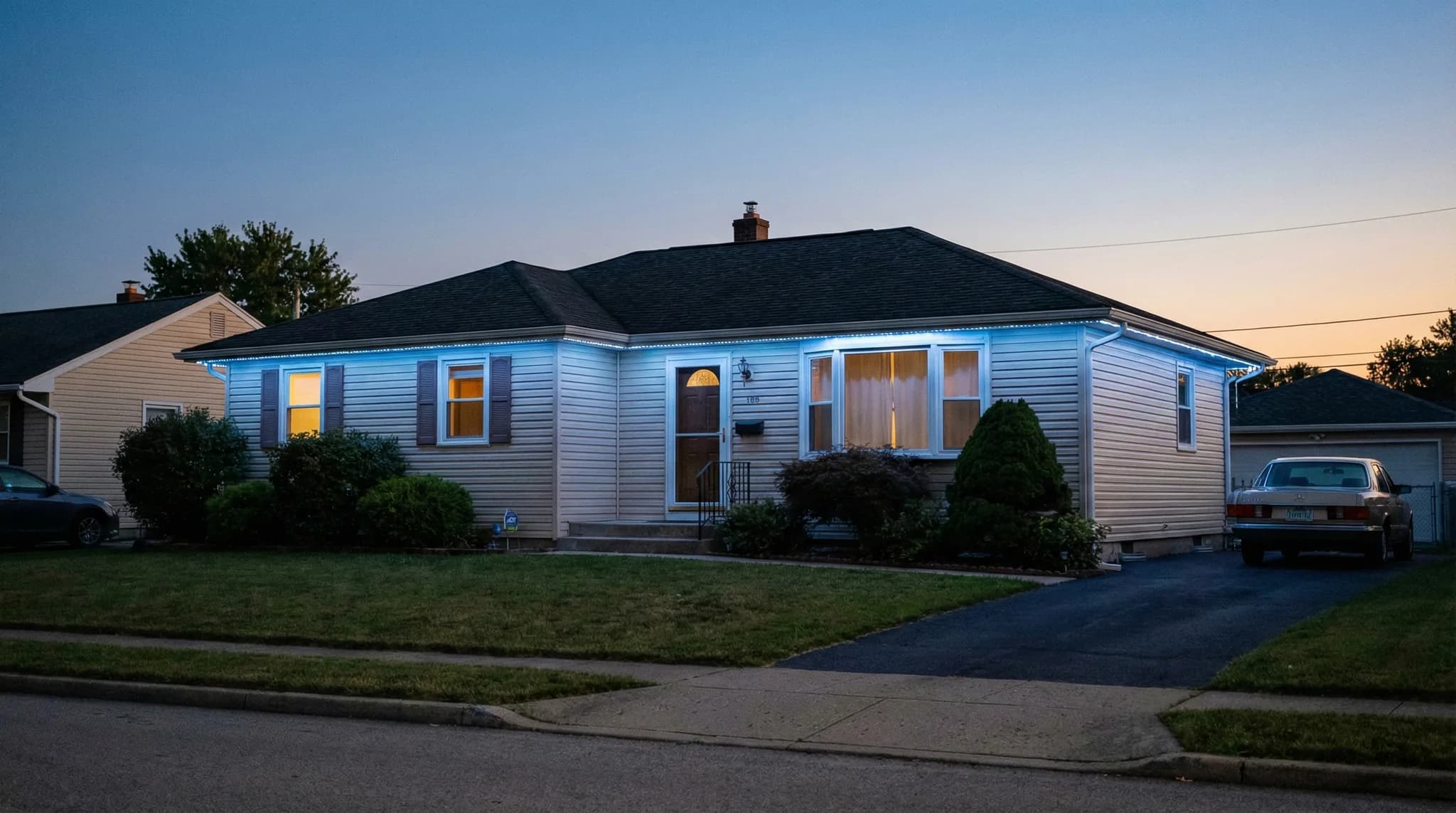
What looks like a simple string of Christmas lights is actually a low-voltage, addressable LED system: aluminum channel, RGBIC chips, a 24V transformer, and a WiFi controller doing real engineering behind the scenes.
If you are trying to understand how permanent Christmas lights work before spending $3,000 to $8,000 on a Sacramento or Roseville install, the short answer is: it is a low-voltage LED system with four components working together. An aluminum channel under your eave holds the lights. RGBIC chips inside each LED node let every bulb display its own color. A 24V transformer steps household power down. And a WiFi controller turns phone taps into the exact pulse of data each chip needs to read.
That is the whole system. But each of those four pieces is doing real engineering, and understanding how they connect is the difference between a system that lasts 25 years on a Sacramento roofline and one that fails in its second summer. This guide breaks the whole chain down, end to end — from the extruded aluminum profile bolted to your fascia to the bits traveling down the data line at 800 kilohertz.
If you already know how the tech works and just want pricing, jump to our Sacramento permanent outdoor lights cost guide. If you want the brand-by-brand spec breakdown, start with the best permanent outdoor lights for Sacramento homes.
TL;DR: Permanent Christmas lights are an IP67-rated RGBIC LED strip seated inside an aluminum channel mounted under your fascia, wired back to a 24V DC transformer and a WiFi controller. The transformer converts 120V household AC to safe low-voltage DC. The controller sends encoded pulses down a single data wire. Each LED node has its own IC chip that reads its address off that wire and lights up the color the app asked for. The channel protects the LEDs from Sacramento's 140°F summer eaves and 1,800+ hours of annual sun. Everything is controlled from a phone app over WiFi.
The Four Components of a Permanent Christmas Light System
Every professional permanent holiday lighting system — Trimlight, JellyFish, Gemstone, EverLights, Oelo, and EXT Lighting's own installs — is built from the same four functional blocks. Brands differ on chip selection, channel profile, transformer design, and app features, but the underlying architecture is identical.
- Eave-mounted aluminum channel: the physical enclosure that holds the LED strip, diffuses the light, sheds heat, and resists UV and moisture.
- RGBIC LED strip: a continuous run of addressable color LEDs, each with its own integrated circuit chip, wired to shared power and data rails.
- Low-voltage transformer: converts 120V household AC into 12V or 24V DC and provides the steady current the LEDs need to run without flicker.
- WiFi controller + app: bridges your phone, home WiFi, and the LED strip's data protocol — the intelligence layer of the system.
How the Components Connect
That block diagram is the whole story at a high level. Each arrow in the diagram represents a real physical connection — a cable, a data wire, or a wireless link. The sections below walk through each block in detail, starting with the part you can actually see from the street.
How the Eave-Mounted LED Channel Works
The eave channel is the component most homeowners actually ask about first, because it is the only part of the system they can see. Done well, the channel disappears into the drip edge and reads as a clean aluminum trim line during the day. Done poorly, it looks like an aftermarket strip taped to the house.
The channel is an extruded aluminum U-profile, typically 0.75 to 1.25 inches wide and 0.4 to 0.5 inches deep. It is anodized or powder-coated in bronze, black, or white to match the fascia trim. Most professional profiles include a snap-in polycarbonate lens that covers the top face and diffuses the LED light.
Channel Cross-Section: What Is Inside the Profile
Why the Aluminum Profile Matters for Sacramento Installs
Sacramento's climate is not kind to bare LED strips. South-facing and west-facing eaves hit surface temperatures of 130° to 145°F on July afternoons — well above the 125°F safe operating limit of most uncased LED adhesive strips. The aluminum channel is not just a mounting bracket. It is a heat sink that pulls thermal load off the LED chips and radiates it into the fascia cavity, where airflow under the drip edge carries it away.
This is why lightly-built plug-and-play kits sold on Amazon for $400 to $800 fail in their second Sacramento summer, while professional-grade aluminum channel systems hit their rated 50,000+ hour lifespan. For the full durability math on Sacramento's climate conditions, see our guide on how long permanent outdoor lights actually last in Sacramento's climate.
Channel Mounting: Screw Placement, Flashing, and Fascia Protection
The channel mounts directly into the wood fascia using stainless steel #8 or #10 screws, typically spaced every 12 to 18 inches. A proper install includes:
- Pilot holes drilled in the channel only, never through the fascia wood, so the screw threads bite into fresh wood on the first pass
- Silicone sealant behind each screw head to prevent moisture wicking into the fascia
- Channel mounted under the drip edge, not on top of the shingles, so roof runoff sheds over the channel rather than into it
- 1/4 inch expansion gap between channel sections so aluminum thermal expansion in summer does not buckle the strip
- End caps and J-channel transitions at every corner and termination to keep water, bugs, and wasps out
Installation detail is a significant portion of long-term performance. For a full walkthrough of what the install day actually looks like on a typical Sacramento home, see what to expect when getting permanent lights installed. Stucco and tile roof homes need extra care — we cover those specifically in our stucco and tile roof installation guide.
Pro Tip
When you compare installer quotes, ask whether the aluminum channel is a full extruded U-profile or a lightweight J-track that only clips the LEDs. Full extruded profiles with a snap-in lens resist UV yellowing, block direct rain, and last 25+ years. J-tracks leave the LED strip partially exposed and often fail first on south-facing Sacramento eaves. The difference in quote price is usually $200 to $600 — a small premium over a 20-year lifespan.
Inside an RGBIC LED Node: The Chip That Makes Addressing Possible
The LED strip seated inside the channel is not a single light — it is a continuous run of individual nodes, usually spaced 3 to 6 inches apart. Each node contains four electrical components: three colored LED diodes (red, green, blue), an integrated circuit (IC) chip that handles addressing, and a small set of surface-mount resistors.
The IC chip is the reason permanent Christmas lights can display rainbow gradients, chasing effects, or different colors on different sections of the roof at the same time. Without it, every node on the same circuit would be locked to the same color. This is the fundamental difference between a modern permanent system and the static light strings you bought 20 years ago.
How Chip Addressing Works on the Data Wire
The Mechanics: How Each Node Reads Its Own Address
The controller encodes colors as 24-bit values — 8 bits for red, 8 bits for green, 8 bits for blue, producing the familiar 16.7 million color range. It concatenates the values for every node on the strip into a single pulse train and sends that train down the data wire at a rate of roughly 800 kilohertz (for WS2812B chips — other protocols use different speeds).
Each IC chip grabs the first 24 bits it sees, stores those as its own color values, then forwards everything after bit 24 to the next node downstream. The second node grabs the next 24 bits, forwards the rest, and so on. By the time the pulse train reaches node 200 on a roofline, nodes 1 through 199 have already consumed their bits, and node 200 sees exactly the 24 bits meant for it.
This is called a serial daisy-chain protocol, and it is the reason you only need one data wire — not 200 separate wires — to give 200 nodes independent control. The tradeoff is that if a single IC chip in the middle of the run fails completely, every node after it goes dark. Professional systems build in redundancy, but the diagnostic pattern of the failure (dark from a certain point onward) is a dead giveaway for a single blown IC.
The most common IC chips used in the Sacramento permanent lighting market are the WS2811 (controls 3 LEDs at a time), the WS2812B (per-LED addressing, 800 kHz), and the SK6812 (per-LED, supports a fourth white channel for RGBW nodes — sometimes called RGBICW). For a deeper look at the color-technology tradeoffs between RGB, RGBW, and RGBIC, see RGB vs RGBW vs RGBIC permanent outdoor lights.
What Addressing Unlocks
Once every node can be controlled independently, the system stops being a string of lights and starts being a low-resolution display. That is why modern permanent Christmas light apps can do:
- Rainbow gradients that fade smoothly from one end of the roof to the other
- Chasing patterns where a color appears to run along the eave at any speed
- Alternating sections — candy cane red and white at Christmas, orange and purple for Halloween, red and green every third node, whatever the app allows
- Meteor and shooting-star effects where a bright pulse streaks across the roofline and fades out
- Music sync via a microphone in the controller (or audio over WiFi) that maps frequencies to specific nodes
- Holiday scenes — preset patterns for Christmas, Independence Day, Halloween, Easter, Valentine's Day, and team-color game days
For a full library of seasonal patterns Sacramento homeowners actually use, see our holiday lighting scenes and patterns playbook.
The Low-Voltage Side: 24V DC, Transformers, and Wire Gauge
Everything downstream of the transformer runs at 24 volts DC or lower. That is a deliberate engineering decision with three direct benefits for a Sacramento homeowner:
- Safety: 24V DC is below the threshold for electrical shock risk. You can cut a live cable and touch both ends with no meaningful danger. This matters during roofline work and future troubleshooting.
- Permit treatment: Sacramento County and the City of Roseville classify permanent outdoor lighting systems with factory-sealed low-voltage transformers as plug-in landscape lighting, which generally does not require a building permit. High-voltage 120V systems would trigger electrical permit requirements.
- Failure isolation: A water intrusion or physical damage on a 24V system causes an LED to go out. The same event on a 120V system can start a fire or trip a household breaker. The low-voltage architecture is why permanent LED systems do not appear on typical homeowner insurance exclusion lists.
For a deeper look at the full safety-versus-performance tradeoff between low-voltage and high-voltage outdoor lighting systems, our low voltage vs high voltage permanent outdoor lights guide covers both sides in detail.
What the Transformer Actually Does
The transformer performs three jobs in a single weatherproof enclosure, usually mounted in the garage, on an exterior wall, or tucked under the eave near the outlet it plugs into.
- Step down: uses a magnetic transformer coil (or a modern switching regulator) to convert 120V AC household current to 24V AC
- Rectify: a bridge rectifier converts the 24V AC to 24V DC that the LED drivers need
- Filter and regulate: capacitors smooth out the DC ripple, and a constant-current regulator holds voltage steady as the load changes (e.g., when you go from one color to full white, which draws more current)
How Transformer Size Is Selected for Your Home
Transformer wattage is sized by total LED load plus a safety headroom. The rule of thumb professionals use is:
(number of LED nodes) × (watts per node at full white) × 1.2 safety factor = minimum transformer watts
A typical RGBIC node draws 0.7 to 1.2 watts at full white. Most installers design to 1.0 W per node for conservative sizing. The chart below shows typical transformer sizing for Sacramento homes by linear feet of lighted roofline.
Professional installers oversize the transformer by 20% to 30% against the calculated load to extend transformer lifespan and handle the inrush current when you fire a full-white scene instantly. An undersized transformer runs hot, sags under load, and causes visible flicker or color inconsistency across the strip — one of the most common reasons a DIY kit looks worse than a professional install.
For more context on what Sacramento homes of different sizes actually cost to install, see permanent outdoor lights pricing by home size.
Wire Gauge and Voltage Drop — Why Long Runs Need Beefier Cable
Low-voltage systems have one engineering weakness: voltage drop. As 24V DC travels down a long wire, the wire's resistance converts some of the voltage into heat, and the LEDs at the far end see less than 24V. Below about 20V, many LED drivers start dimming visibly or shifting color temperature.
Installers manage voltage drop three ways:
- Larger wire gauge — 12 AWG or 10 AWG for long trunk runs instead of the 18 AWG often used inside the strip itself. Lower AWG number means thicker wire and less resistance.
- Center-fed topology — the controller feeds power into the middle of the LED run, so the longest distance from transformer to any single LED is cut in half
- Power injection points — dedicated power taps every 50 to 75 feet along a long run, keeping every node within spec
On a typical 2,500 sq ft Sacramento home with ~200 linear feet of roofline, a well-designed system will have a single transformer and a center-fed controller, with one or two power injection points on the longer elevations. A 3,500+ sq ft home with multiple dormers or a detached garage may use two transformers and two controllers to isolate the load.
The WiFi Controller: How the App Actually Talks to Your Lights
The WiFi controller is the system's brain. Physically, it is a small weatherproof box, usually 3 × 4 × 1 inches, mounted next to or near the transformer. Electrically, it takes 24V DC power from the transformer, holds a microprocessor, a 2.4 GHz WiFi radio, and driver circuitry that generates the high-speed pulse train the LEDs need.
The Command Path from Your Phone to the Eave
Here is the actual sequence of events when you open the app and tap “Christmas Red & Green Alternating”:
- App composes a command. The app knows how many nodes your system has, their positions, and your saved zones. It generates a JSON-like payload: for node 1, set RGB to (255, 0, 0); for node 2, set RGB to (0, 255, 0); repeat down the strip.
- Payload travels over WiFi. On your home network, the phone sends the payload directly to the controller's local IP. If you are away from home, it routes through the manufacturer's cloud service and back to the controller via an outbound WiFi connection.
- Controller parses the command. The microprocessor validates the payload and builds an internal frame buffer — basically an array where each slot holds the 24-bit RGB value for one LED node.
- Driver circuit emits pulses. Dedicated hardware (often a shift register or DMA channel) clocks the frame buffer out the data pin at 800 kHz, generating the precise square-wave pulse train the IC chips can decode.
- LEDs update. Each IC chip along the strip latches its 24 bits and turns on. The whole update happens in under 30 milliseconds for a 200-node system. Including WiFi round-trip, total latency from tap to light change is typically under 200 milliseconds on a healthy home network.
That sub-200ms latency is why app-driven animations feel smooth, why music sync actually tracks the beat, and why scheduling is accurate to the second. If your permanent lights feel sluggish or require multiple taps to respond, the bottleneck is almost always the WiFi connection between your router and the controller, not the controller itself.
Smart Home Integration
Modern controllers expose APIs for the common smart home platforms:
- Amazon Alexa — voice commands (“Alexa, Christmas mode”) and inclusion in routines
- Google Home / Google Assistant — similar voice and routine integration
- Apple HomeKit — supported by some brands directly, others via bridges
- SmartThings — scene control and automation triggers
- IFTTT / Matter — supported on newer controllers, enabling cross-platform automations (lights turn red when the Sacramento Kings win, for example)
For the full walkthrough of how Alexa and Google Home integration works on permanent lighting systems in Sacramento, see permanent outdoor lights and home automation. To understand what app control looks like day-to-day, see our smart permanent outdoor lights guide.
Full Component Reference Table
The table below summarizes every component of a permanent Christmas light system — what it does, what a typical spec looks like, and where it lives in the install.
| Component | Function | Typical Spec | Location |
|---|---|---|---|
| Aluminum channel | Physical enclosure, heat sink, UV shield | Extruded 6063 aluminum, 0.75–1.25″ wide | Under drip edge, on fascia |
| Polycarbonate lens | Diffuses LEDs, blocks rain, resists UV | UV-stabilized, 2–3mm thick, snap-in | Top face of channel |
| RGBIC LED strip | Produces light; each node independently addressable | IP67, 3–6″ node spacing, WS2812B/SK6812 | Inside channel |
| IC chip (per node) | Reads its address, sets RGB output, forwards data | WS2811/WS2812B/SK6812, 800 kHz NRZ | Embedded in each LED package |
| Transformer | 120V AC → 24V DC; regulates current | 150W–500W, weatherproof enclosure | Garage or exterior wall near outlet |
| WiFi controller | Translates app commands into LED pulse train | 2.4 GHz WiFi, ESP32 or similar microprocessor | Next to transformer |
| Trunk wiring | Carries 24V power + data from controller to strip | 12–18 AWG, marine-grade silicone ends | Concealed along fascia / down wall |
| Phone app | Scene design, scheduling, voice integration | iOS/Android, cloud + local control | Your phone |
Exact specs vary by brand. Ask your installer to confirm the IC chip, IP rating, transformer wattage, and wire gauge on your specific quote.
What Actually Fails — and Why Most Professional Installs Do Not
A Sacramento homeowner in East Sacramento called us in August 2025 because her two-year-old permanent lights — purchased as a DIY Amazon kit — had gone dark on the west-facing roofline and would not respond to the app. A diagnostic visit found three failure modes stacked on top of each other: the bare LED strip had been adhesive-mounted directly to the fascia without channel, the south-facing LEDs had yellowed and cracked their silicone from UV exposure, and one IC chip 34 nodes down the strip had failed open-circuit — breaking the data line and taking every downstream node dark.
Every one of those failures is eliminated by the architecture described in this article. Aluminum channel with a polycarbonate lens solves the UV and heat problems. Professional-grade IP67 LED strips with marine-grade silicone encapsulation survive Sacramento summers. And addressable IC chips that fail — which is rare in commercial systems — are replaceable without tearing down the whole roofline because the strip is accessible from the channel.
The lesson: every component of a permanent Christmas light system is doing a specific engineering job, and skipping any one of them creates a specific, predictable failure mode. This is also why the DIY vs professional installation math almost always favors a pro install on a Sacramento home that gets 100+ days of direct summer sun on the roofline.
Pro Tip
During a quote walkthrough, ask to see the installer's sample channel and LED strip side-by-side with a bare strip. The difference in build quality is immediately visible. Also ask what happens if a single IC chip fails five years from now — a good installer will explain their repair process and show you where the strip splices cleanly. If the answer is vague, keep shopping. See our how to choose a Sacramento permanent lighting installer guide for the full vetting checklist.
How This System Handles Sacramento and Roseville Weather
Each component of the system has been engineered for a specific environmental threat, and Sacramento, Roseville, and Rocklin happen to present most of them at once:
- UV exposure: the Sacramento metro averages roughly 3,600 hours of sunshine per year, among the highest in California. The polycarbonate lens is UV-stabilized, and the aluminum channel blocks direct LED exposure. Bare strips fail in 2 to 4 years; enclosed strips in 15 to 25.
- Extreme heat: south- and west-facing eaves hit 130–145°F in July. The aluminum channel is the heat sink; the transformer is spec'd for 40°C ambient and mounted in cooler shaded locations where possible. For detailed performance data on Sacramento summers, see permanent outdoor lights in Sacramento's extreme heat.
- Central Valley dust: IP67 rating means the LED strip is fully dust-sealed. The channel lens keeps dust off the LEDs themselves, which otherwise dim over time from surface coating.
- Winter fog and rain: Sacramento gets 18 to 22 inches of rain annually, mostly November through March. IP67 rating handles continuous rain and brief immersion. Silicone-sealed connections handle fog infiltration.
- Occasional freeze: Roseville and Rocklin hit 25–30°F lows a few nights a year. All system components rate to -20°C, well below any realistic winter low.
The full maintenance schedule for Sacramento conditions — when to inspect, when to clean the lens, when to re-seal connections — is covered in our permanent outdoor lights maintenance guide. For the Roseville and Rocklin-specific local installation details, including microclimate notes and the installation permit landscape, see permanent outdoor lights in Roseville and Rocklin.
Frequently Asked Questions
How do permanent Christmas lights actually work?
Permanent Christmas lights are a low-voltage LED system mounted in an aluminum channel under the roofline fascia. The channel holds a continuous strip of RGBIC LED nodes — each with its own addressable microchip — wired to a 24V DC power bus. A transformer steps 120V household power down to 24V, and a WiFi controller reads instructions from your phone app, translates them into data pulses, and sends those pulses down the strip. Every LED node reads its own position in the pulse stream and lights up the exact color and brightness the app asked for, updating many times per second.
How do permanent outdoor lights get their power?
Power enters the system at a standard 120V household outlet — usually a GFCI outlet in the garage or on an exterior wall. A weatherproof transformer plugs into that outlet and steps the voltage down to 24V DC. From the transformer, trunk wiring carries 24V DC and a data line up to the WiFi controller, then along the fascia to the LED strip inside the channel. Nothing on the roofline runs at high voltage — only the transformer enclosure near the outlet sees 120V AC.
What is an eave-mounted LED channel?
An eave-mounted LED channel is the extruded aluminum profile that holds the LED strip along your roofline. It bolts to the wood fascia directly beneath the metal drip edge, usually with stainless steel screws every 12 to 18 inches. The channel is typically 0.75 to 1.25 inches wide, anodized in bronze, black, or white, and capped with a snap-in polycarbonate lens that diffuses the LEDs and protects them from rain, UV, and Sacramento's summer heat. The channel is also a heat sink, which is why professional-grade installs outlast bare LED strips by 10 to 20 years.
What does RGBIC stand for in permanent Christmas lights?
RGBIC stands for Red, Green, Blue, Independent Control. Each LED node on an RGBIC strip contains three colored diodes plus a small integrated circuit (IC) chip — commonly a WS2811, WS2812B, or SK6812. The IC chip reads the node's own address off a shared data line and lights up the diodes to exactly the color the controller requested. Because every node has its own chip, every node can display a different color simultaneously — which is what makes rainbow gradients, chasing patterns, and multi-color holiday scenes possible.
Are permanent Christmas lights AC or DC?
The LED strip runs on low-voltage DC (24V in professional systems; 12V in some older or budget kits). The 120V AC that comes out of your household outlet is converted to 24V DC inside the transformer, which is a weatherproof enclosure mounted near the outlet. All wiring downstream of the transformer — including everything on the roofline — is 24V DC. This is why permanent light systems are safe to troubleshoot and generally do not require building permits in Sacramento County.
How does the app talk to the lights?
The WiFi controller has a 2.4 GHz WiFi radio that joins your home WiFi network during setup. When you open the app and tap a scene, the app composes a JSON-style command listing the color for every node, sends it to the controller over WiFi (directly if you are home, via the manufacturer's cloud if you are away), and the controller translates the command into the high-speed pulse train the IC chips expect. Total latency from tap to light change is typically under 200 milliseconds on a healthy home network.
Can a single failed LED take down the whole strip?
Yes, if it is a true open-circuit failure of the IC chip in that node. Because addressable strips daisy-chain the data line from one node to the next, a broken data path in the middle of the strip stops data from reaching every downstream node. In practice, this is rare on professional-grade IP67 systems — the sealed encapsulation and heat-sinked channel protect the IC chips. When it does happen, a qualified installer can splice in a replacement section without tearing down the whole roofline.
How much does it cost to run permanent Christmas lights each month?
Very little. A typical 200-node RGBIC system on a 2,500 sq ft Sacramento home draws roughly 200 watts at full white brightness — about the same as two old-school incandescent bulbs. Running an average of 5 hours per night at typical brightness, electricity cost comes to about $3 to $6 per month on Sacramento SMUD rates. For the full electricity math by home size and SMUD tier, see our permanent outdoor lights electricity cost breakdown.
Now You Know Exactly What You Are Buying
A permanent Christmas light system looks like a simple string of lights from the curb. Inside the eave channel, it is a proper piece of engineering: addressable RGBIC chips running a serial data protocol at 800 kilohertz, a low-voltage DC power bus sized to your roofline, a WiFi controller bridging your phone and the strip, and an aluminum enclosure built to survive two decades of Sacramento sun.
Understanding how the pieces work together is the best filter for installer quotes. Ask about the channel profile, the IC chip, the transformer wattage, the IP rating, and the wire gauge. A good Sacramento installer will have quick, specific answers. A bad one will deflect.
EXT Lighting installs professional-grade permanent outdoor lighting systems across Sacramento, Roseville, Rocklin, Folsom, and El Dorado Hills. Every install uses full extruded aluminum channel, IP67 RGBIC LED strips, properly sized 24V transformers, and WiFi controllers with Alexa and Google Home integration — all backed by a lifetime warranty on parts and labor.
Request a free property assessment to see what a permanent system would look like on your home, or explore our residential lighting services to see recent installations in the Sacramento area. If you are weighing this investment against temporary holiday light services, start with our permanent outdoor lights vs Christmas lights comparison.