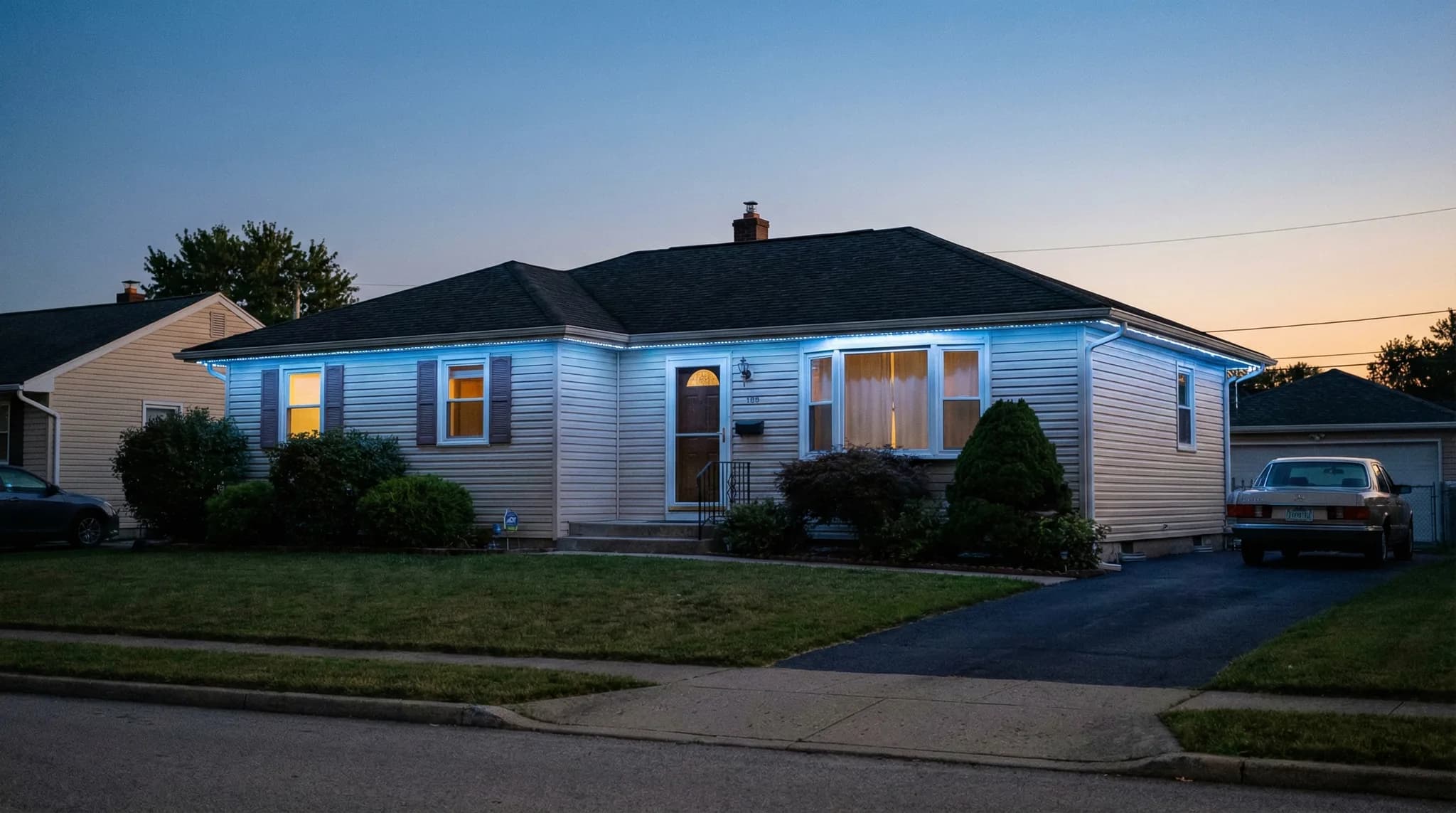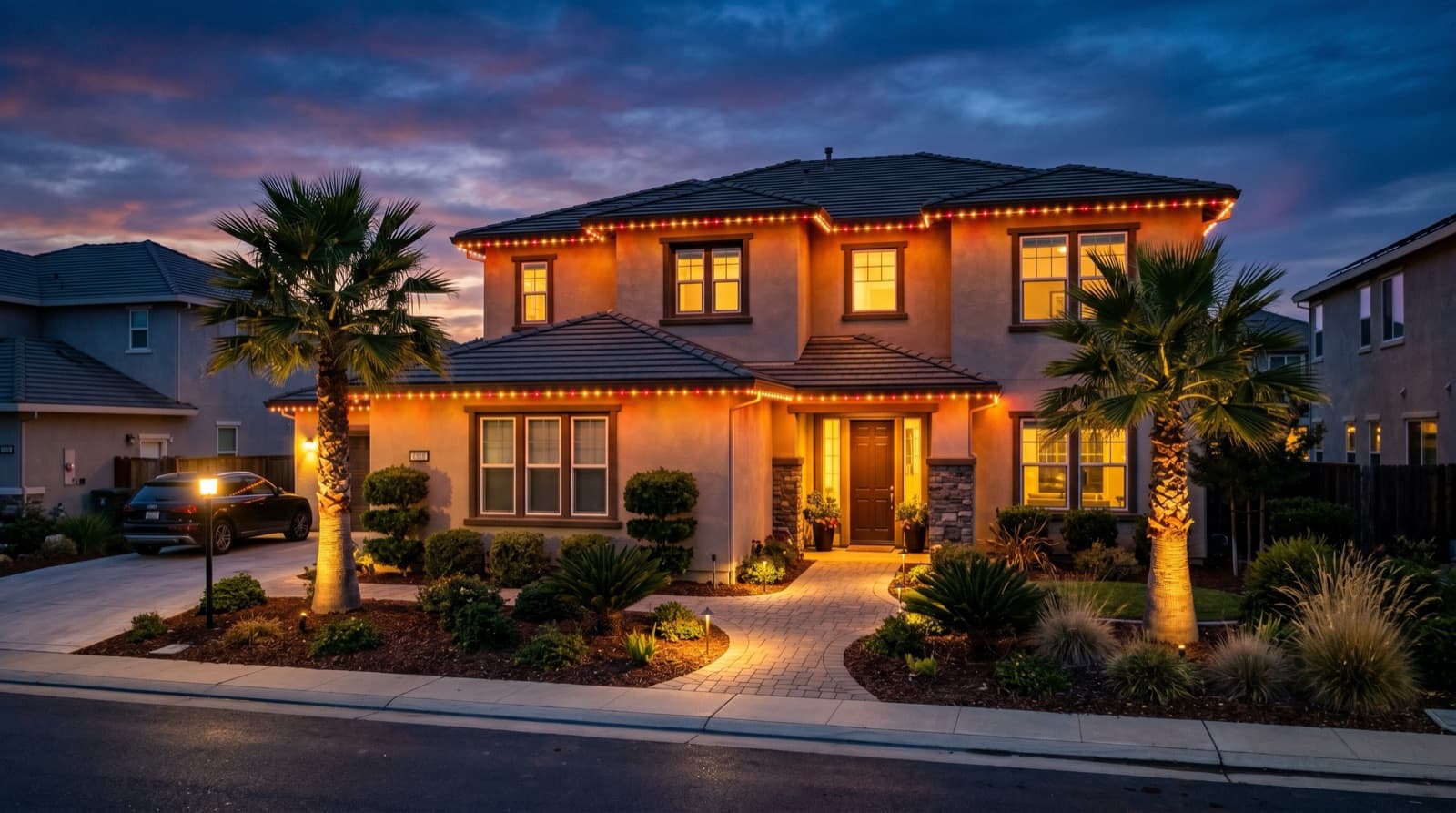
The same permanent LED track handles Diwali gold, Halloween orange and purple, and July 4th red-white-blue – controlled entirely from the app.
Permanent outdoor lights for Diwali, Halloween, and July 4th turn one roofline installation into a full multicultural holiday calendar, run from a phone and scheduled months in advance. Sacramento, Elk Grove, and Folsom homeowners program the same LED track to shift from warm Diwali gold in late October to Halloween orange and purple days later, and back to patriotic red-white-blue zones by July 4th – with no ladders, no rewiring, and no hardware swaps between holidays.
The Sacramento metro has one of the fastest-growing South Asian populations in Northern California, with Elk Grove alone home to more than 30,000 residents of Indian and South Asian descent (U.S. Census Bureau, 2023 American Community Survey 5-year estimates). Diwali exterior lighting is a long-running tradition that most homeowners previously handled with strings of diyas, string lights, and temporary LED strands. Permanent outdoor lights fold Diwali into the same system that already handles Christmas, Halloween, and July 4th – which is where the math starts to favor a single install over year-after-year temporary setups.
This guide covers the specific color patterns, app scheduling, brightness settings, and cultural framing for each of these three holidays, plus a practical programming playbook for Elk Grove, Folsom, and greater Sacramento homeowners running permanent LED systems. For the full everyday pattern library, start with the holiday lighting patterns and scenes guide, and for the automation side, see the year-round scheduling playbook.
TL;DR: Permanent outdoor lights support every non-Christmas holiday through the same app-controlled LED track that handles Christmas. Diwali runs warm gold, amber, and deep red at 75–85% brightness across the five festival nights (typically late October to early November). Halloween uses orange and purple at 80–100% brightness for the full month of October. July 4th uses red, white, and blue in large zone blocks at 90–100% brightness from Memorial Day weekend through July 5th. All three holidays can be scheduled months ahead and transition automatically on their target dates. Sacramento and Elk Grove homeowners already own the hardware – the patterns are a software setting, not a new install.
Can Permanent Outdoor Lights Do Diwali Patterns?
Yes. Every professionally installed permanent outdoor lighting system in Sacramento – Trimlight, JellyFish, Gemstone, EverLights, and EXT Lighting installs – uses RGB or RGBW individually addressable LEDs capable of 16 million+ color combinations. The warm gold, amber, and deep red tones traditional to Diwali lighting are core colors in every app's preset library, and all four pattern types (static, alternating, chase, fade) work with those palettes.
Diwali – the festival of lights – is a five-day Hindu, Sikh, and Jain celebration that culminates on the darkest night of the Hindu lunar month of Kartik (typically late October or early November on the Gregorian calendar). The exterior lighting tradition centers on diyas (small oil lamps), candles, and strings of warm white or golden lights placed along rooflines, railings, doorways, and windows. The visual language is warm – gold, amber, saffron, deep red – and the symbolism is the triumph of light over darkness and good over evil.
Permanent LED systems reproduce this palette with far more consistency than string lights, and with none of the fire risk of open-flame diyas (which many Elk Grove and Folsom HOAs restrict on exterior surfaces). The system respects the visual tradition, simply using modern hardware to sustain it across the full five nights without the setup and takedown ritual most families would rather spend with relatives than on a ladder.
Diwali Color Palette Recommendations
The most culturally grounded Diwali palette for permanent outdoor lights combines three warm tones along the roofline with a slow-fade or alternating pattern. Avoid cool white, blue, and green – those read as Christmas or Hanukkah, not Diwali.
- Warm gold (approx. 2700K–3000K warm white or amber): The dominant color. Run this across 60–70% of the roofline to mirror the glow of traditional diya oil lamps.
- Deep saffron / burnt orange: Accent color, 20–25% of the roofline. Saffron carries cultural weight in Hindu tradition and pairs beautifully with warm gold.
- Deep red (not bright Christmas red): Minor accent, 10–15% of the roofline. Evokes the red and gold combination central to Lakshmi Puja and Diwali decor.
- Optional: warm rose gold or muted pink: Some families add a softer fourth tone for a more modern palette. Keep it warm – cool pink reads as Valentine's.
The Five Nights of Diwali: Scene-by-Scene
Diwali is a five-day festival, and many families vary the lighting subtly across those five nights. Here is a practical scene sequence that permanent LED systems handle cleanly:
- Day 1 – Dhanteras: Warm gold static across the full roofline at 70% brightness. A quiet, welcoming opening.
- Day 2 – Naraka Chaturdashi (Choti Diwali): Warm gold with amber accent in alternating groups of 5 LEDs at 75% brightness.
- Day 3 – Diwali / Lakshmi Puja (main night): Full palette – gold, saffron, and deep red – in a slow 10-second fade across the roofline at 85% brightness. This is the night to go bigger.
- Day 4 – Govardhan Puja / Padwa: Gold and saffron alternating at 75% brightness. Keep the celebration visible but dial back slightly from the main night.
- Day 5 – Bhai Dooj: Return to warm gold static at 70% brightness – a reflective closing to the festival that transitions naturally into the everyday warm white default.
Pro Tip: Schedule your Diwali sequence in the app the week before the festival starts. Use the date-based scheduler to assign a different scene to each of the five nights, with automatic transitions at sunset. This is the one holiday where day-to-day variation matters, and pre-scheduling means the lights shift correctly even if you're hosting and not near your phone when the day changes.
Diwali lighting pairs naturally with interior lamps, diyas (where safe and HOA-permitted), and rangoli floor art at the entryway. The permanent LED roofline ties the full visual composition together and carries the tradition from dusk through late evening without anyone needing to re-light candles.
Do Permanent Outdoor Lights Work for Halloween?
Yes. Halloween is the second-largest decorating holiday in the United States, and permanent outdoor lights handle every exterior lighting scenario Halloween calls for. According to the National Retail Federation 2024 Halloween survey, Americans planned to spend $11.6 billion on Halloween, with outdoor decorations among the top purchase categories. Permanent systems replace the annual haul of orange string lights with a programmable LED track that runs for the full month of October and shuts off on its own.
Halloween is also the holiday where Sacramento homeowners get the most mileage out of brighter, bolder settings. Other holidays reward restraint. Halloween rewards commitment.
The Three Core Halloween Patterns
Most Sacramento homes run one of three patterns for October:
- Orange and purple alternating: The classic Halloween roofline. Groups of 4–5 LEDs, orange dominant (60–70%), purple accent (30–40%). Run at 80–100% brightness. Set this scene October 1st and let it hold through November 1st, then transition to harvest amber.
- Slow purple chase: A single bright purple pulse travels along the roofline against a darker purple background. One full chase cycle every 4–6 seconds. This creates atmospheric motion that reads intentional rather than frantic. Works especially well on Craftsman, Tudor, and older East Sacramento architecture.
- Red-to-green slow fade: An eerie, unsettling whole-roofline transition between deep red and deep green over 10–12 seconds. Less common than orange-purple but hauntingly effective on dark streets. Avoid on homes where the roofline sits close to neighboring properties – the slow shift can draw complaints.
Halloween Programming Specifics
Halloween is the rare holiday where chase and motion effects earn their keep. Static patterns can feel flat for a holiday built on atmosphere. The key is speed: slow motion reads spooky, fast motion reads cheap.
For trick-or-treat night specifically (October 31st), many Elk Grove and Rancho Cordova families program a special scene that activates at 5:30 PM and runs at 100% brightness until 9 PM, then automatically dims to 50% for the rest of the evening. This maximizes visibility during the peak trick-or-treat window without leaving the full intensity running past neighborhood bedtime.
Pro Tip: Sacramento's fall pollen and wildfire smoke season (September through early October) can leave a fine film on LED lenses that mutes colors – especially orange and purple. A quick garden-hose rinse the weekend before October 1st restores full color vibrancy. Build it into the same fall prep routine as gutter cleaning.
For the full pattern customization reference, see our holiday lighting patterns guide, and for the everyday color temperature choices you're building on top of, see the best permanent outdoor lighting colors guide.
How Do You Program Permanent Lights for July 4th?
July 4th programming on permanent outdoor lights centers on red, white, and blue in large zone blocks – not individual alternating LEDs. The reason is optical: alternating red-white-blue on a per-LED basis blurs into a muddy pink-purple from the street, especially under the lingering golden-hour light of a Sacramento July evening.
Sacramento summer sunset sits after 8:30 PM through early July. That means patriotic lighting needs to fight ambient daylight for at least an hour after the scene activates, which is the opposite problem from Christmas (when full dark arrives by 5:15 PM). Brightness settings have to compensate.
The Three-Zone Block Method
The most effective July 4th configuration divides the roofline into three approximately equal zones – one red, one white, one blue. This reads cleanly from 40+ feet away and maintains distinct color identity even as ambient light shifts.
- Zone 1 (left 1/3 of roofline): Saturated red at 90–100% brightness.
- Zone 2 (middle 1/3): Cool white (5000K) at 100% brightness. White needs full brightness because it competes hardest with ambient daylight.
- Zone 3 (right 1/3): Saturated blue at 90–100% brightness.
Most apps let you draw these zones by dragging zone markers on a roofline diagram, so you can match the split to your home's architectural lines – breaking zones at gables, dormers, or porch peaks for cleaner visual divisions.
Alternative: Red-White-Blue Slow Fade
A whole-roofline slow fade cycling red → white → blue every 10–15 seconds is the most complimented July 4th pattern in our Sacramento installs. The gentle movement draws the eye without the visual noise of chase effects, and it handles the transition from daylight to full dark without looking different at either end of the evening.
Pro Tip: Schedule your July 4th scene to activate at 7:30 PM and dim to 70% brightness at 11 PM. That covers the 8:30 PM Sacramento sunset and the peak fireworks window at Cal Expo, Folsom Lake, and neighborhood shows, then politely dials back for overnight. Most HOA lighting complaints come from systems left at full intensity past midnight, not from the colors themselves.
Multi-Holiday Permanent Lighting Sacramento Calendar
The practical value of a multi-holiday permanent lighting system is the calendar density. A Sacramento-area home running the three-holiday playbook (plus Christmas) picks up 4 distinct lighting seasons totaling roughly 12 weeks of active holiday programming – alongside the everyday warm white default that covers the other 40 weeks. For families that also run Eid, Hanukkah, Lunar New Year, Easter, or Thanksgiving scenes, active holiday programming can climb to 18 to 20 weeks per year.
Here is a consolidated programming reference covering the three holidays this guide focuses on, plus the surrounding Sacramento calendar context:
| Holiday | Dominant Colors | Pattern Type | Brightness | Typical Dates |
|---|---|---|---|---|
| Diwali (Day 1 – 2) | Warm gold, amber | Static / alternating | 70–75% | Late Oct (varies) |
| Diwali (Day 3 main) | Gold, saffron, deep red | Slow fade | 80–85% | Lakshmi Puja night |
| Diwali (Day 4 – 5) | Gold, amber | Static / alternating | 70–75% | Early Nov |
| Halloween (Oct) | Orange, purple | Alternating or chase | 80–100% | Oct 1 – Nov 1 |
| Trick-or-Treat Night | Orange, purple | Alternating (bold) | 100% → 50% | Oct 31 (5:30 PM→9 PM) |
| July 4th | Red, white, blue | Zone blocks | 90–100% | May 25 – Jul 5 |
| Memorial Day Weekend | Red, white, blue | Slow fade | 85–95% | Late May |
| Everyday Default | Warm white (2700K) | Static solid | 40–60% | Non-holiday evenings |
This table is the starting point, not the final configuration. Most homeowners tweak brightness by 5 to 10 percentage points depending on their specific street conditions – homes near streetlights need slightly more brightness, homes on darker cul-de-sacs need slightly less.
How to Schedule Diwali, Halloween, and July 4th in Advance
Every major permanent lighting app supports date-based scene scheduling. Set the full multicultural holiday calendar once in the spring, and the system transitions automatically all year. The scheduling workflow takes about 20 minutes for the full calendar.
- Build the Diwali scene library first. Save five custom scenes (one per festival night) with the exact color distributions, brightness settings, and fade timings from the sections above. Name them clearly (“Diwali Day 1 – Dhanteras” etc.) so you can find them quickly.
- Build the Halloween scene. Save one primary Halloween scene (orange-purple alternating) and one trick-or-treat scene (100% brightness version with the 9 PM auto-dim). Link them through the app's schedule builder.
- Build the July 4th scene. Save the three-zone red-white-blue scene and the slow-fade alternative. Many families pick one for Memorial Day and the other for July 4th to create subtle variety across the six-week patriotic window.
- Assign dates in the app's calendar view. Drag each scene onto its target date. Diwali dates vary year to year – look up the specific dates in advance (2026 Diwali falls November 8–12). Halloween and July 4th are fixed.
- Set sunset-based activation times. Every app lets you activate scenes at local sunset rather than a fixed clock time. Use this. It keeps the system natural across the seasonal sunset shift.
- Set overnight dim or off rules. 10 PM dim to 30% or off handles every HOA expectation in Sacramento, Elk Grove, Folsom, and Rocklin. Apply the rule globally once.
For the full year-round scheduling playbook including warm white defaults, Sacramento Kings game nights, and personal events, see the permanent lights scheduling guide.
Cultural Holiday Lighting in Elk Grove, Folsom, and Surrounding Areas
Elk Grove has one of the largest South Asian populations in the Sacramento metro, anchored around the Krishna Temple on Grant Line Road and the growing corridor of Indian grocery, restaurant, and community businesses along Elk Grove Boulevard and Bond Road. Diwali celebrations at Elk Grove Regional Park, the Elk Grove Public Library, and private homes across Laguna Ridge, Stonelake, and Lakeside draw thousands of attendees each fall.
Folsom has seen similar South Asian population growth, especially around the Folsom Ranch, Empire Ranch, and Russell Ranch developments. Diwali decor is now visible across neighborhoods that five years ago would have run Christmas lights and nothing else. Permanent LED systems make this shift practical – no family wants to handle two separate temporary light installations five weeks apart in late fall.
Mini-Story: An Elk Grove Laguna Ridge Install
A Laguna Ridge family we worked with in 2025 had been running temporary orange Halloween string lights, taking them down November 1st, hanging a separate set of warm white Diwali strings for the five-night festival, taking those down mid-November, then hanging Christmas lights for Thanksgiving. Three setups and two takedowns in six weeks, every year, on a two-story home with a tile roof.
After installing permanent LEDs, the same home now runs Halloween orange-purple from October 1st, auto-transitions to Diwali gold-saffron-red on the festival's first night (scheduled once each fall when dates are confirmed), auto-transitions to harvest amber on November 15th, and switches to classic Christmas red-and-green the day after Thanksgiving. Zero ladders, zero takedowns, zero weekends lost to install work. The system paid for itself in time savings alone inside two years.
For Folsom and El Dorado Hills-specific install considerations – HOA submittals for Serrano, Empire Ranch, and Broadstone, tile-roof mounting, hillside access – see the Folsom / El Dorado Hills / Granite Bay local guide. For Roseville and Rocklin specifics, see the Roseville and Rocklin local guide.
HOA and Neighborhood Considerations Across Holidays
Sacramento-area HOAs generally allow holiday lighting during culturally recognized seasons. Most community CC&Rs were written with Christmas in mind and don't explicitly address Diwali, Halloween patterns, or July 4th programming – which means permanent lights usually sail through approval as long as they respect the baseline brightness and timing rules that already cover Christmas installs.
- Diwali: No Sacramento-area HOA we have encountered restricts Diwali-specific color palettes. The warm gold and amber tones read as tasteful holiday lighting to review boards. Five-night duration is well within any “holiday lighting window” rule that applies to Christmas.
- Halloween: Chase patterns are where HOAs occasionally push back. If your community's CC&Rs prohibit “flashing or strobing” exterior lighting, set chase cycle speeds to 4+ seconds per pass and you'll stay compliant. Fast strobe effects are the actual prohibition target.
- July 4th: Patriotic colors are universally approved. Brightness is the only watch-out – the 100% settings needed for visible red-white-blue in late-evening daylight can draw complaints if not dimmed at 11 PM. Use the overnight dim rule.
For the full Sacramento-area HOA breakdown including Serrano, Empire Ranch, Broadstone, and other specific community rules, see our HOA rules guide for permanent outdoor lights.
Do Multi-Holiday Patterns Cost More to Run?
No. Pattern type (static, alternating, fade, chase) has no effect on electricity consumption. Brightness is the only variable that moves power draw. A permanent lighting system running Diwali gold at 75% brightness consumes the same electricity as the same system running Christmas red-and-green at 75% brightness – and less than the same system running July 4th red-white-blue at 95%.
According to the U.S. Department of Energy, LED lighting uses at least 75% less energy than traditional incandescent lighting. Sacramento SMUD residential electricity rates in 2025 average about 16 to 18 cents per kWh, and most whole-home permanent LED systems run on 2 to 5 amps at 24V DC, which equates to roughly $3 to $8 per month in operating cost. Running all four major holidays fully is well within that envelope.
For the detailed monthly cost breakdown including SMUD tier pricing and holiday-season peak usage, see our Sacramento electricity cost guide.
How to Get Started with Multi-Holiday Permanent Lighting
If you already own a permanent lighting system, the patterns in this guide are a software setting, not a hardware upgrade. Open your manufacturer's app, build the Diwali, Halloween, and July 4th scenes using the color and brightness specs above, save them to your scene library, and schedule them on the calendar. Budget about 20 minutes the first time.
If you're considering installation, the best time to schedule is well before the early-fall peak season. September and October are the busiest install windows across Sacramento, Elk Grove, Folsom, and Rocklin – lead times can stretch to 6 to 8 weeks. Booking by late spring or early summer gives you time to have the system installed, commissioned, and scene-programmed before Diwali and Halloween both arrive in the same late-October window. For seasonal timing details, see our best time to install guide.
Frequently Asked Questions: Diwali, Halloween, and July 4th Lighting
Can permanent lights do Diwali patterns?
Yes. Every RGB or RGBW permanent outdoor lighting system handles the warm gold, amber, saffron, and deep red palette traditional to Diwali. All four pattern types (static, alternating, chase, slow fade) work with that palette, and most apps ship with preset Diwali or warm-gold scenes out of the box. The same hardware that handles Christmas and Halloween handles Diwali with no add-ons.
Do permanent outdoor lights work for Halloween?
Yes. Halloween is one of the most common use cases for permanent outdoor lights. The orange-purple alternating pattern is built into every major app's preset library, and the full month of October is handled by a single scheduled scene. Permanent lights eliminate the annual Halloween string-light haul and handle chase patterns, fades, and atmospheric motion that string lights can't reproduce.
How do you program permanent lights for July 4th?
Divide your roofline into three approximately equal zones – one red, one white (cool 5000K), one blue – at 90–100% brightness. Avoid per-LED alternating red-white-blue, which blurs into muddy pink-purple from the street. Schedule the scene to activate at sunset (around 7:30 PM in early July in Sacramento) and dim to 70% at 11 PM. Run from Memorial Day weekend through July 5th for full patriotic-holiday coverage.
What holidays can you program permanent lights for?
Any holiday or event with associated colors. Major covered holidays include Christmas, Halloween, July 4th, Diwali, Hanukkah, Valentine's Day, Easter, Thanksgiving, Memorial Day, Veterans Day, St. Patrick's Day, Lunar New Year, and Eid. Cultural and personal events including Sacramento Kings game nights, gender reveals, graduation parties, birthdays, anniversaries, and school-color nights are also common uses. The system doesn't distinguish between “holidays” and “events” – every scene is just a saved color configuration.
Do permanent lights have pre-built Diwali scenes?
Several manufacturers now ship pre-built Diwali presets in their scene libraries, especially newer 2024–2026 app versions. If your app doesn't include one, building a custom Diwali scene takes under five minutes: select warm gold (2700K), deep saffron, and deep red; set distribution to 65/22/13 percent; choose slow fade or alternating; save to your scene library. Subsequent years, it's a one-tap activation.
Will Halloween chase patterns violate HOA rules in Elk Grove or Folsom?
Unlikely, as long as chase speed is 4+ seconds per cycle. Most HOA exterior lighting restrictions target rapid strobe and flashing effects, not slow atmospheric motion. Slow purple chase patterns on Halloween are generally well-received and rarely draw complaints in Laguna Ridge, Stonelake, Empire Ranch, Russell Ranch, or other Sacramento-area planned communities. For the full HOA breakdown, see our HOA rules guide.
Can I run different Diwali scenes on each of the five festival nights?
Yes. Every permanent lighting app supports unlimited custom scenes and date-based scheduling. Save five distinct Diwali scenes (one per festival night) and assign each to its target date through the app's calendar view. The system transitions automatically at sunset each evening. Since Diwali dates shift year to year on the Gregorian calendar, plan to update the date assignments once per year when festival dates are confirmed.
Bring Every Holiday Onto One Lighting System
Permanent outdoor lights are the rare home improvement where multicultural holiday capability is standard, not an upgrade. The same LED track that handles Christmas red-and-green handles Diwali gold-saffron-red, Halloween orange-purple, and July 4th red-white-blue – with no additional hardware, no seasonal install work, and no additional electricity cost.
Sacramento, Elk Grove, and Folsom homeowners who treat holiday exterior lighting as a core part of family tradition get the most out of these systems. The math on time saved alone pays the install back inside two to three years, and the cultural continuity of a warmly lit home across Halloween, Diwali, and July 4th – without ladders, without string-light tangles, without compromise – is the actual product.
Book a Free Multi-Holiday Lighting Consultation
On-site linear footage measurement, elevation photos, custom scene design for Diwali, Halloween, July 4th, and Christmas, plus a written fixed-price quote within 48 hours. Lifetime warranty on parts and labor across Sacramento, Elk Grove, Folsom, Rocklin, and surrounding communities.
Request a Free Quote