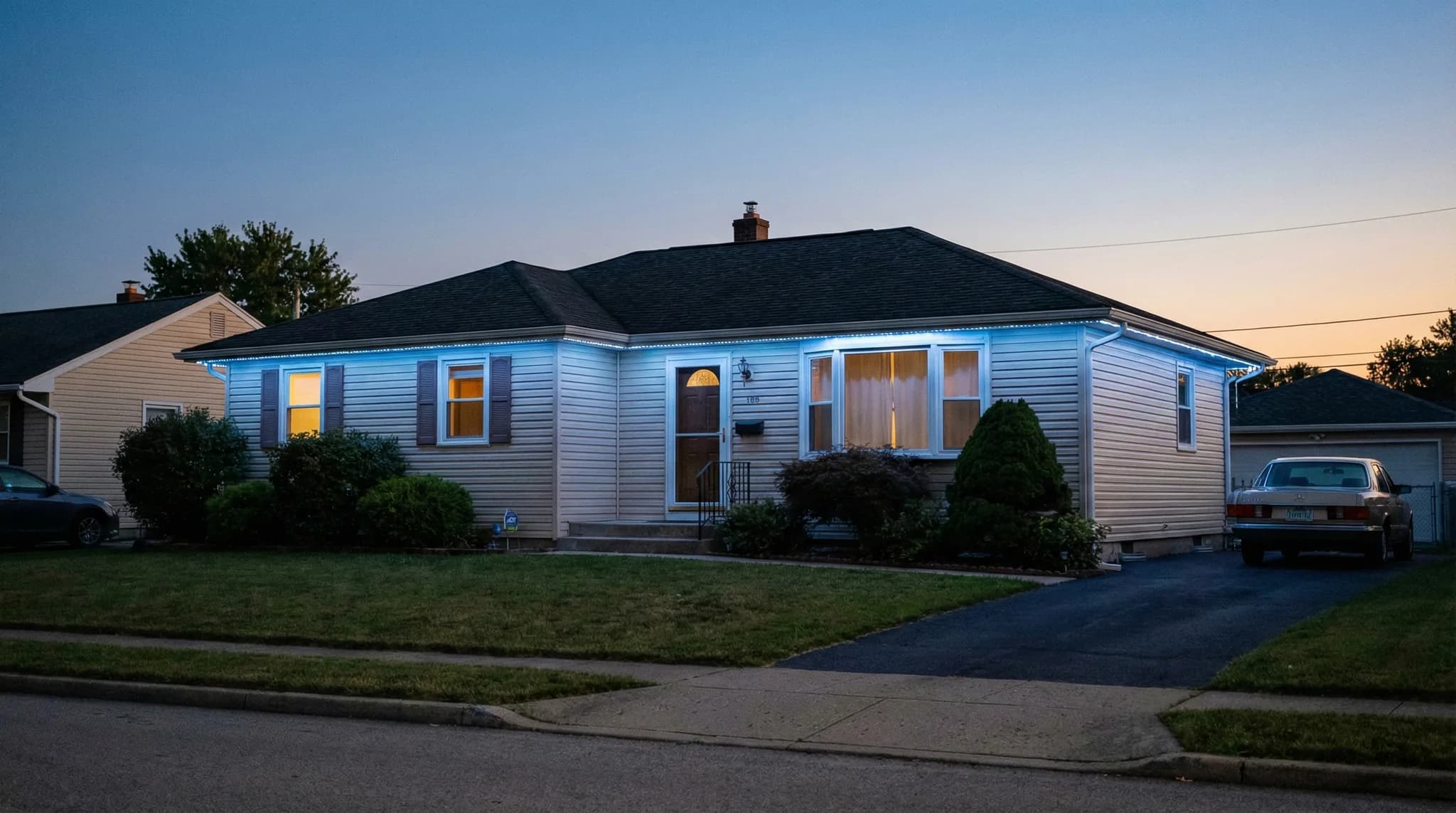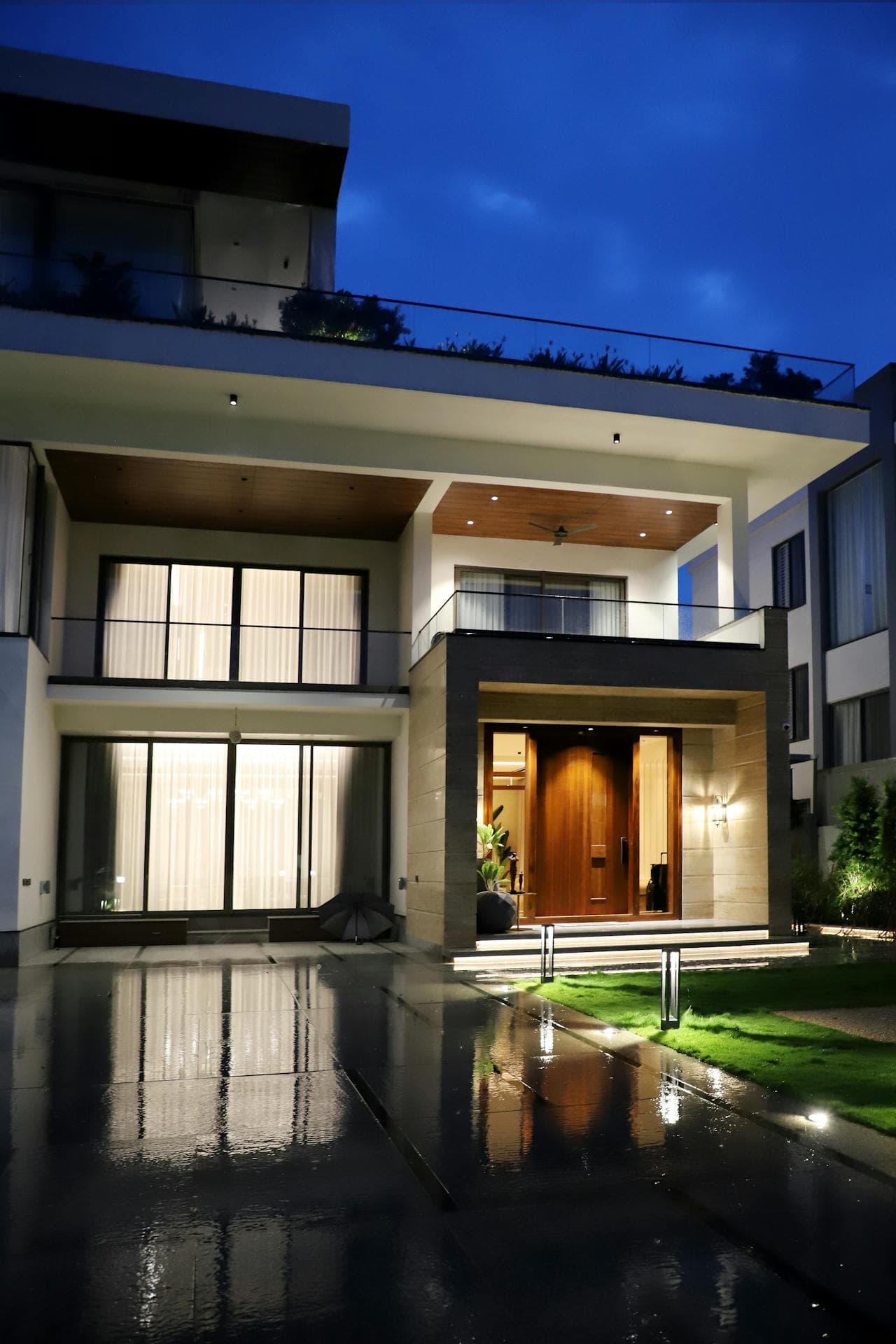
Permanent outdoor LED systems use RGB, RGBW, or RGBIC technology to produce millions of colors – but the underlying chip configuration determines white light quality, color effects, and long-term value.
RGB, RGBW, and RGBIC are the three LED color technologies used in permanent outdoor lighting systems, and they are not interchangeable. Each uses a different chip configuration that affects white light quality, color range, dynamic effects, and price. Sacramento homeowners comparing permanent outdoor lights need to understand these differences before committing to a system that will stay on their roofline for 15 to 25 years.
The short answer: RGB mixes red, green, and blue chips to produce colors but creates a washed-out white. RGBW adds a dedicated white LED chip for clean, accurate white light. RGBIC adds independent control (IC) chips so each LED node can display a different color simultaneously – enabling rainbow fades, chasing effects, and animated patterns that standard RGB and RGBW cannot produce.
This guide breaks down the technical differences, compares real-world performance for permanent outdoor lighting, and helps you match the right technology to your priorities. Already know which technology you want and need pricing? Check our Sacramento permanent outdoor lights cost guide for real numbers by home size.
TL;DR: For most Sacramento homeowners, RGBW is the best balance of color variety and everyday usability – it produces vivid holiday colors plus clean warm white for nightly accent lighting. RGB is the budget option but creates poor white light. RGBIC delivers the most dynamic effects (rainbow waves, music sync, multi-color patterns) but costs more and adds complexity. The “IC” in RGBIC is a control technology, not a color technology – it can be paired with RGB or RGBW bases.
What Is RGB and How Does It Work in Permanent Outdoor Lights?
RGB stands for Red, Green, Blue – the three primary colors of the additive light model. Every RGB LED node contains three separate diode chips, one for each color. By adjusting the intensity of each chip from 0% to 100%, the controller mixes them to produce a theoretical range of over 16 million color combinations.
RGB is the most established and affordable color-changing LED technology. It works well for saturated, vivid colors – deep reds, bright greens, electric blues. Holiday displays look great in RGB because holiday colors are typically fully saturated.
Where RGB Falls Short
The problem is white light. When all three RGB channels fire at 100%, the resulting “white” has a noticeable bluish or purple tint. The human eye is remarkably sensitive to white light quality, and most homeowners who run their permanent lights nightly default to warm white (2700K to 3000K) about 90% of the time. RGB cannot produce that warm, natural tone.
Some RGB systems attempt to compensate with software-adjusted whites, dimming certain channels to approximate warmth. The results vary, but they never match a dedicated white LED. If you plan to use your permanent lights primarily for everyday accent lighting with occasional holiday color, this limitation matters. For a deeper look at how most homeowners actually use their colors throughout the year, see our guide to permanent outdoor lighting colors by season.
Best Use Case for RGB
- Budget-conscious installations where holiday color is the primary goal
- Homeowners who plan to turn lights off rather than run white nightly
- Commercial buildings where vivid branding colors matter more than white
What Is RGBW and Why Do Most Installers Recommend It?
RGBW adds a fourth LED chip – a dedicated warm white diode (typically 2700K to 3000K) – alongside the standard red, green, and blue chips. This is a 4-in-1 LED package that solves RGB's biggest weakness: white light quality. If you're weighing which white temperature to run as your everyday color, our guide to the best color temperature for permanent outdoor lights compares warm white, cool white, and daylight options in detail.
With RGBW, the white channel operates independently. When you want warm white, the system uses the dedicated white chip – not a mix of red, green, and blue. The result is the same clean, warm glow you'd expect from a high-quality incandescent bulb, but with the full color spectrum available at the tap of a button.
How RGBW Improves Color Accuracy Beyond White
The dedicated white chip also improves pastel colors. Pastels – soft pinks, lavenders, peach tones – require mixing white with color. In an RGB system, that white component is always slightly blue-tinted, making pastels look cooler than intended. RGBW pastels are warmer and more accurate because the white component comes from a real white LED.
This matters for Sacramento homeowners who want soft, inviting colors for patio entertaining or subtle accent lighting. The difference between an RGB pastel and an RGBW pastel is immediately visible side by side.
What Sacramento Homeowners Choose Most Often
In our experience installing permanent lighting systems across the Sacramento metro, roughly 80% of homeowners run warm white as their default evening setting. They switch to colors for holidays, birthdays, game days, and special events – maybe 30 to 50 nights per year. RGBW handles both modes well. RGB handles the color nights fine but underperforms on the other 300+ nights of warm white.
If you are weighing whether the RGBW premium is worth it, consider how you actually plan to use your lights year-round. For ideas beyond holidays, explore our year-round uses for permanent outdoor lights.
Pro Tip
When comparing quotes from different installers, ask specifically whether the system uses RGB or RGBW LEDs. Some lower-priced quotes use RGB-only to hit a lower price point, but the white light difference is noticeable every night. The RGBW upgrade typically adds $200 to $500 to a whole-home system – a small premium over a 15+ year lifespan. See our full cost breakdown for context.
What Is RGBIC and What Does the “IC” Stand For?
RGBIC stands for Red, Green, Blue, Independent Control (sometimes called Integrated Circuit). The “IC” refers to a tiny microchip embedded in each LED node – or in small groups of nodes – that allows each one to be addressed and controlled independently from a single data line.
Standard RGB and RGBW systems are “non-addressable.” Every LED on a given zone or channel displays the same color at the same time. If you set Zone 1 to red, every node in Zone 1 is red. RGBIC breaks that constraint. Each node (or segment of 3 to 6 nodes) can display a different color simultaneously, enabling effects like:
- Rainbow gradients: A smooth color fade from one end of the roofline to the other
- Chasing patterns: Colors that appear to “move” along the roofline
- Music synchronization: Lights react to music in real time, changing color and brightness with the beat
- Meteor/shooting star effects: A burst of light that streaks across the roofline
- Multi-color static displays: Red and green alternating for Christmas, or team colors in a pattern
The IC Chips Behind the Technology
The most common IC chips used in permanent outdoor lighting systems are the WS2811, WS2812B, and SK6812. The WS2811 controls LEDs in groups of 3, while the WS2812B and SK6812 offer per-LED addressability. The SK6812 variant supports RGBW (four channels), combining independent control with a dedicated white chip – this is sometimes labeled RGBICW.
For permanent outdoor lighting, the IC chip model matters less than the overall system design. Professional-grade systems from brands like Trimlight, Gemstone, and JellyFish all use addressable IC technology in their current product lines, though they differ on channel count (RGB vs. RGBW base), zone configuration, and app capabilities. For a brand-by-brand comparison, see our Sacramento permanent outdoor lights brand guide.
What RGBIC Cannot Do
RGBIC adds control complexity. More individually addressable nodes means more data flowing through the system, which can introduce latency in very long runs. Some RGBIC strips also cannot be cut and re-soldered at arbitrary points without losing address mapping – a consideration for custom roofline installations.
Additionally, RGBIC is a control technology, not a color technology. An RGBIC system built on an RGB base still cannot produce clean white light. Only RGBICW (RGBIC with a dedicated white chip) solves both the addressability and white quality problems. Make sure your installer specifies the full designation, not just “RGBIC.”
RGB vs. RGBW vs. RGBIC: Side-by-Side Comparison
The table below compares the three technologies across the specs that matter most for permanent outdoor lighting installations in Sacramento.
| Feature | RGB | RGBW | RGBIC |
|---|---|---|---|
| LED Chips per Node | 3 (R, G, B) | 4 (R, G, B, W) | 3 or 4 + IC chip |
| Color Range | 16M+ colors | 16M+ colors + pure white | 16M+ colors per node |
| White Light Quality | Poor (bluish tint) | Excellent (dedicated 2700K–3000K) | Depends on base (RGB or RGBW) |
| Individual Node Control | No (whole zone) | No (whole zone) | Yes (per node/segment) |
| Dynamic Effects | Static color, basic fade | Static color, basic fade | Rainbow, chase, meteor, music sync |
| Pastel Accuracy | Fair (cool-tinted) | Good (warm, natural) | Depends on base |
| Relative Cost | $ (lowest) | $$ (mid-range) | $$$ (highest) |
| Best For | Budget, holiday-only use | Daily accent + holiday color | Dynamic effects, light shows |
RGBIC systems built on an RGBW base (sometimes called RGBICW) combine the best of both: independent control plus dedicated white light. Verify the base color technology with your installer.
How Each Technology Scores Across Key Criteria
Which Technology Do the Major Permanent Lighting Brands Use?
The five major professional permanent outdoor lighting brands available in the Sacramento market each make different technology choices. Understanding which brand uses which technology helps narrow your decision.
- Trimlight: Uses RGB LEDs with addressable IC control in their current Select and Edge product lines. Individual node addressability enables dynamic patterns and music sync. No dedicated white chip in the standard configuration.
- Gemstone Lights: Uses RGBW technology with a dedicated warm white channel. Excellent everyday white light quality. Supports color-changing and scheduled themes through their cloud-based app. Their 3-LED-per-node design produces brighter output per point.
- JellyFish Lighting: Uses RGB LEDs with addressable IC control. Strong dynamic effect library and app-based zone management. Like Trimlight, the standard system does not include a dedicated white chip.
- EverLights: Offers RGB systems with multiple LED spacing options (6″, 9″, 12″). Addressable with app control. Budget-friendly positioning.
- Oelo: Uses RGBW technology with a dedicated white LED. Available in multiple spacing configurations. Varies by dealer in terms of warranty and app platform.
For a detailed spec-by-spec comparison of these five brands – including IP ratings, warranty terms, mounting methods, and Sacramento climate performance – see our best permanent outdoor lights for Sacramento homes guide.
Brand Technology at a Glance
How Does Color Technology Affect Your Electricity Bill?
LED technology uses approximately 75% less energy than incandescent alternatives, according to the U.S. Department of Energy. But the specific LED color technology adds a small variable to power consumption.
Here's how the three technologies compare on power draw:
- RGB: Three active channels at maximum brightness. A typical 200-node roofline system draws 100 to 200 watts at full output.
- RGBW: Four active channels, but the white channel typically runs alone for daily use (not stacked on top of RGB). Practical daily draw is similar to RGB or slightly lower, because a single white channel is more efficient than mixing three channels to approximate white.
- RGBIC: Same per-node power as the base technology (RGB or RGBW). The IC chip adds negligible draw – milliwatts per node. The total system draw is effectively identical to a non-addressable system of the same LED count.
On Sacramento's SMUD residential rate of approximately $0.12 per kWh, a 200-watt system running 6 hours nightly costs about $4.30 per month regardless of whether it uses RGB, RGBW, or RGBIC technology. The color technology choice does not meaningfully change your operating cost. For a full breakdown of permanent lighting electricity costs, see our electricity cost guide for Sacramento homeowners.
RGB vs. RGBW vs. RGBIC: Which Should Sacramento Homeowners Choose?
The right technology depends on three things: how you plan to use your lights most often, what effects you want available, and your budget. Here's a decision framework based on common Sacramento homeowner profiles.
Choose RGB If:
- Your primary goal is holiday color displays (Christmas, Halloween, July 4th)
- You rarely plan to run white accent lighting nightly
- Budget is the top priority and you want the lowest possible installed cost
- You are comfortable with the bluish tone of mixed-channel white
Choose RGBW If:
- You want clean warm white for everyday evening use (the most common preference)
- You value accurate pastels and subtle color washes for patio entertaining
- You want full holiday color capability without compromising daily lighting quality
- You prioritize long-term satisfaction over the lowest upfront cost
Choose RGBIC If:
- Dynamic effects matter to you: rainbow fades, chasing lights, music sync
- You want the most visually impressive holiday displays possible
- You're willing to pay a premium for per-node control and advanced animations
- You host events or parties where a “light show” effect adds value
Quick Decision Flowchart
Pro Tip
If you want both warm white quality and dynamic effects, ask your installer about RGBICW systems (RGBIC with a dedicated white chip). This combines the per-node addressability of RGBIC with the clean white of RGBW. It is the premium option and not every brand offers it yet, but it eliminates the trade-off between the two technologies entirely.
Want to see how these technologies look on an actual Sacramento home? Request a free consultation and we can show you live demos of RGB, RGBW, and RGBIC systems during a property assessment. No pressure, no commitment – just a chance to see the difference firsthand.
How Color Technology Connects to Smart Home Features
The color technology (RGB, RGBW, RGBIC) determines what colors and effects your system can display. The smart control layer determines how you manage those colors – through app control, scheduling, voice assistants, and home automation platforms.
All three technologies work with smart app control. The difference is that RGBIC systems have more to control – per-node color assignment, animation speed, direction of chasing effects, music sync sensitivity. That translates to a more feature-rich (and slightly more complex) app experience.
For a deep dive into app features, scheduling, and smart home integration, see our smart permanent outdoor lights guide. If you want to connect your permanent lights to Alexa, Google Home, or Apple HomeKit, read our home automation integration guide.
Durability and Maintenance Differences by Technology
All three technologies use the same underlying LED diode physics. An RGB LED, an RGBW LED, and an RGBIC LED are all rated for 50,000+ hours of operation (roughly 15 to 25 years at 6 hours per night). The color technology does not significantly affect lifespan.
What does affect durability in Sacramento's climate is IP rating, housing material, and mounting method – factors that are independent of color technology. A well-built RGB system with IP67 protection will outlast a poorly sealed RGBIC system with IP65.
One nuance: RGBIC systems have slightly more electronic components per node (the IC chip). In theory, that's one more potential failure point. In practice, IC chip failures are rare in professional-grade systems and are covered under warranty. If a single node's IC fails, it typically affects only that node – the rest of the system continues working.
Maintenance requirements are identical across all three technologies: occasional rinse with a garden hose to clear Sacramento's pollen and dust, and a visual inspection twice a year. For a complete maintenance schedule, see our Sacramento permanent lights maintenance guide.
LED Lifespan Is the Same Across All Three Technologies
What About RGBCW, RGBWW, and RGBCCT?
You may encounter additional acronyms during your research. Here's what they mean and whether they matter for permanent outdoor lighting:
- RGBCW (RGB + Cool White): Adds a cool white (5000K to 6500K) LED instead of warm white. Less common for residential exterior use because cool white reads as “commercial” to most homeowners.
- RGBWW (RGB + Warm White): Functionally identical to RGBW with a warm white chip. The “WW” explicitly specifies warm white (2700K to 3000K), which is already the standard in most RGBW outdoor systems.
- RGBCCT (RGB + Correlated Color Temperature): A 5-in-1 chip with RGB plus both warm and cool white channels. Allows tuning the white color temperature from warm to cool. This is the premium option for maximum white light flexibility but adds cost and is less common in the permanent outdoor lighting market.
For most Sacramento homeowners, the practical choice remains between RGB, RGBW, and RGBIC (or RGBICW). The extended variants above are available through some suppliers but are not standard in the major brand product lines currently serving the Sacramento market.
Frequently Asked Questions
What is the difference between RGB and RGBW permanent outdoor lights?
RGB uses three LED chips (red, green, blue) and produces colors by mixing those three channels. RGBW adds a fourth chip – a dedicated warm white LED (2700K to 3000K). The difference is most noticeable in white light: RGB white has a bluish tint because it mixes all three colored channels, while RGBW produces clean, natural warm white from its dedicated chip. For homeowners who run white most nights, RGBW is the better investment.
What does RGBIC mean for outdoor lighting?
RGBIC stands for Red, Green, Blue, Independent Control. Each LED node has its own IC (integrated circuit) chip, allowing it to display a different color from its neighbors simultaneously. This enables dynamic effects like rainbow gradients, chasing patterns, and music synchronization that standard RGB and RGBW systems cannot produce. RGBIC is a control technology – it can be paired with either an RGB or RGBW color base.
Which is better for permanent outdoor lights: RGB or RGBW?
RGBW is better for most homeowners. The dedicated white chip provides clean, warm white light for everyday accent use – which is how the majority of Sacramento homeowners use their lights 90% of the time. Both technologies produce equally vivid saturated colors for holidays. The RGBW upgrade adds roughly $200 to $500 to a typical whole-home system, a small premium over a 15+ year lifespan.
Do RGB, RGBW, and RGBIC lights use different amounts of electricity?
No meaningful difference. All three use LED technology that consumes approximately 75% less energy than incandescent alternatives (U.S. Department of Energy). A typical 200-node permanent system costs about $4 to $5 per month to run on Sacramento SMUD rates regardless of color technology. The IC chip in RGBIC systems adds negligible power draw.
Can I upgrade from RGB to RGBW or RGBIC after installation?
Upgrading the LED track usually requires replacing the entire light strip, since the chip configuration is built into each node. The controller may or may not be compatible with a different LED type. In most cases, upgrading color technology means a full system replacement. This is why choosing the right technology upfront matters – consult our durability guide to understand the long-term commitment.
Do all permanent outdoor lighting brands offer RGBIC?
Not all. As of 2026, Trimlight and JellyFish offer addressable IC-controlled systems. Gemstone and Oelo use non-addressable RGBW. EverLights offers addressable RGB. Brand technology varies by product line and generation – ask your installer which specific product they install and confirm whether it uses RGB, RGBW, or RGBIC before signing a contract.
The Right Technology Starts with the Right Installer
RGB, RGBW, and RGBIC each serve different priorities. RGB is the budget option with the widest availability. RGBW is the best all-around choice for homeowners who value everyday warm white plus holiday color flexibility. RGBIC delivers the most visually impressive dynamic effects for homeowners willing to pay the premium.
The technology matters, but so does the installer. A well-installed RGBW system with proper IP67+ weatherproofing, mechanical mounting, and UV-resistant housing will outperform a poorly installed RGBIC system with adhesive mounting and insufficient weather sealing. Sacramento's 100°F+ summers and Central Valley dust make installation quality at least as important as LED technology choice.
EXT Lighting installs professional-grade permanent outdoor lighting systems across Sacramento, Roseville, Rocklin, Folsom, El Dorado Hills, and the surrounding area. We can walk you through the technology options during a free property assessment and recommend the right system for your home, budget, and priorities.
Request a free quote to get started, or explore our residential lighting services to see recent installations in the Sacramento area.