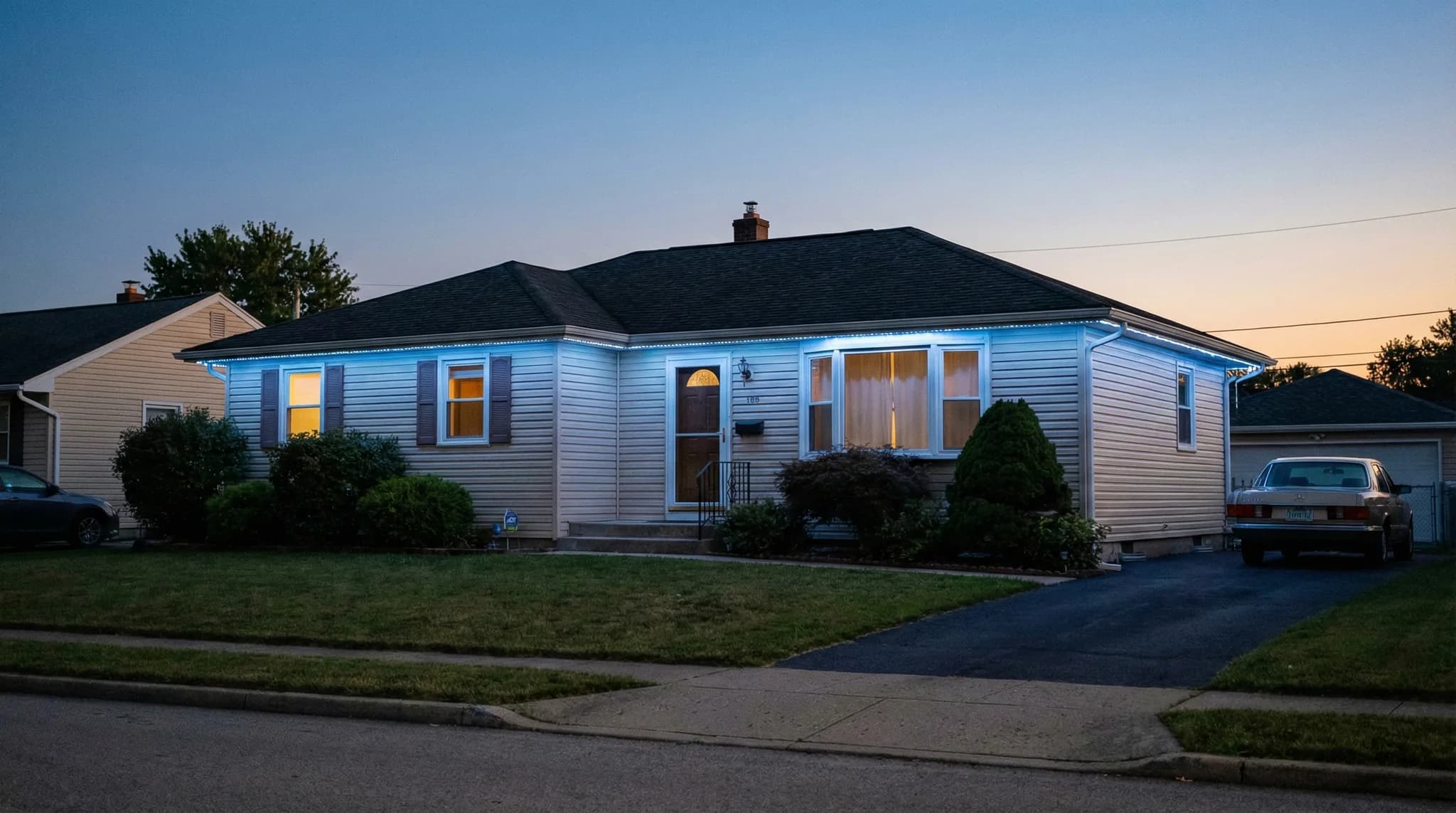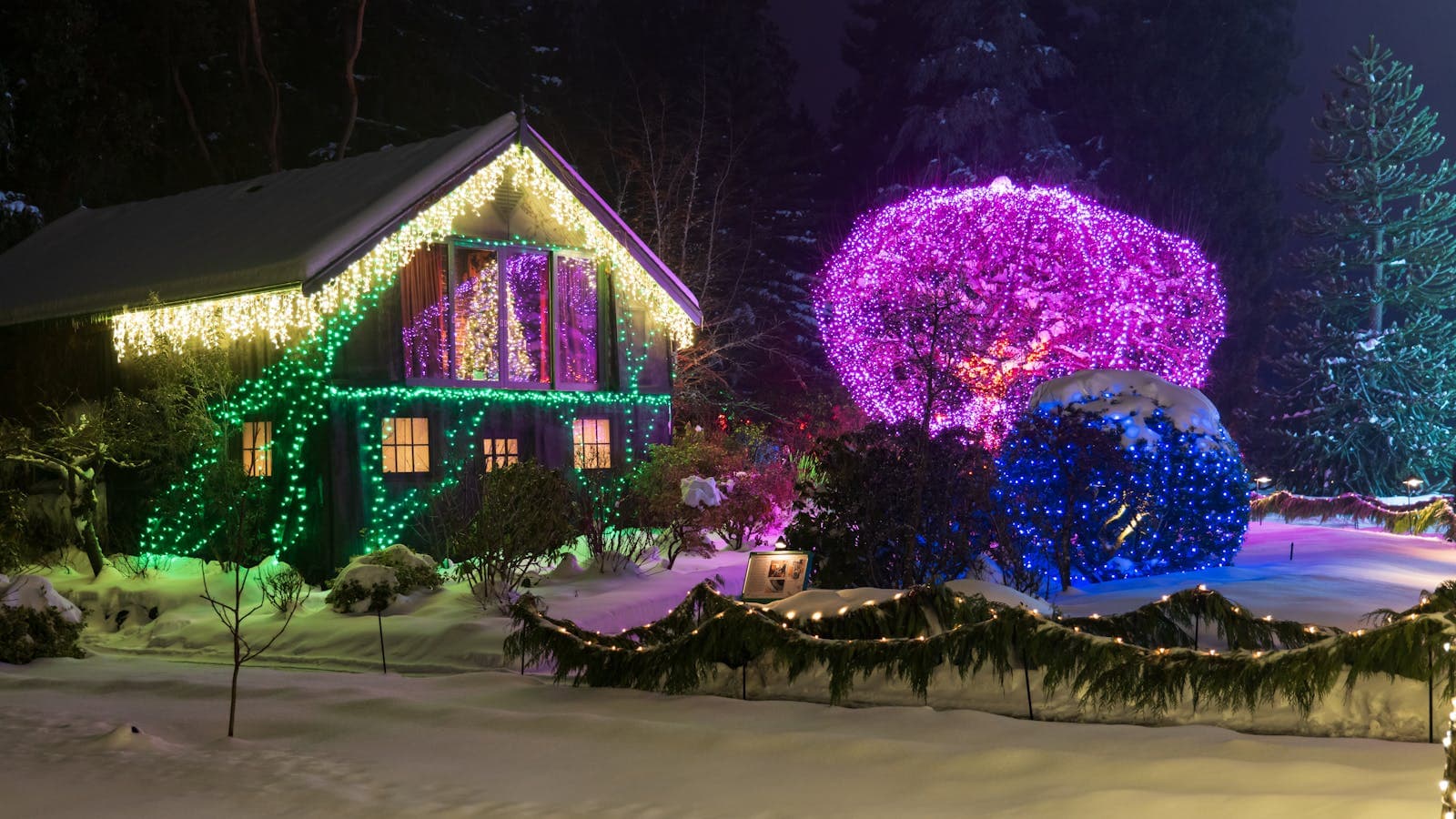
Sacramento homeowners are skipping the ladder routine entirely by installing permanent app-controlled holiday lights once and never climbing again.
You can have holiday lights without a ladder by installing permanent app-controlled LED lights along your roofline once and running them from your phone every December after that. Sacramento homeowners who switch eliminate the ladder, the storage tub in the garage, the November weekend lost to install, and the January weekend lost to takedown. The lights stay up year-round, hidden in a low-profile channel that disappears against the fascia in daylight, and turn on with a tap.
This matters more than it sounds. The U.S. Consumer Product Safety Commission tracks more than 164,000 ladder-related emergency room visits each year (CPSC, 2024). Roughly 5,800 of those happen during the November-through-January holiday season specifically, according to the American Academy of Orthopaedic Surgeons. Falls from roofs and ladders during holiday decorating account for an estimated 200 fatalities annually in the United States.
This guide covers why the no-ladder approach is taking over in Sacramento, the math on time and money saved, what app-controlled permanent holiday lights actually do, and how to decide whether skipping the Christmas install forever makes sense for your home. For a side-by-side cost comparison with traditional strands, see our permanent outdoor lights vs. Christmas lights guide.
TL;DR: Holiday lights without a ladder means installing permanent LED lights along the roofline once (professionally, in a single day) and running them from a phone app for every holiday after that. Sacramento homeowners save 4–12 hours per year on install and takedown, eliminate the ladder fall risk that sends 5,800+ Americans to the ER each December, and recover the system cost in 4–5 years versus paying $400+ annually for temporary install services. The lights are invisible in daylight and serve double-duty as accent and security lighting year-round.
The Real Cost of Putting Up Christmas Lights Every Year
Most Sacramento homeowners underestimate the true cost of the annual ladder routine. The visible cost is the strand of lights from the hardware store. The hidden cost is everything else.
- Time – The average homeowner spends 4 to 12 hours per year on holiday light install and takedown for a typical single-family Sacramento home. That includes hauling out the bins, untangling, climbing, clipping, plugging in timers, and reversing the entire process in January.
- Money on disposable strands – LED Christmas lights cost $20 to $50 per strand, and a typical Sacramento single-family home needs 6 to 12 strands depending on roofline length. Strands fail at a rate of roughly 15 to 25 percent per year due to bulb burnout, wire damage, and rodent chewing in the off-season storage bin.
- Money on installers – Sacramento area temporary holiday light installers charge $300 to $700 per year for install, takedown, and storage of homeowner-supplied or rented strands. Premium service tiers run $800 to $1,500.
- Storage – Holiday lights, ladders, extension cords, and timers consume real garage or attic space 11 months of the year.
- Risk – Every ladder climb is a fall risk. The CPSC reports that 50 percent of ladder injuries involve residential extension or step ladders.
5-Year Cost: Ladder-and-Strand Routine vs. Permanent Lights
The permanent system has a higher upfront cost but the curve flattens. Year 6, 7, 10, and 20 are all $0 of incremental holiday lighting cost. The professionally installed temporary route is roughly $400 a year every year, forever. For full pricing detail, see our permanent outdoor lights cost guide and the ROI breakdown.
Ladder Injuries Are Not Rare. They Are Routine.
The most underrated reason Sacramento homeowners switch to permanent lights is risk avoidance. Ladder accidents during holiday decorating are not freak events.
The U.S. Consumer Product Safety Commission and the American Academy of Orthopaedic Surgeons have tracked these numbers for years.
- 164,000+ total ladder-related ER visits per year in the United States (CPSC, 2024).
- ~5,800 holiday-decoration-specific injuries from falls each November through January (American Academy of Orthopaedic Surgeons).
- ~200 fatalities per year attributed to falls while decorating, primarily from roofs and ladders.
- 50 percent of ladder injuries involve a step ladder or extension ladder used in a residential setting (CPSC).
Sacramento adds a regional wrinkle. December and January in the Sacramento Valley regularly bring tule fog, light morning frost on rooflines, and the occasional rain band. Wet shingles, frost-slick gutters, and damp ladder rungs compound the baseline fall risk that already exists. Two-story homes in newer Roseville, Rocklin, and Folsom subdivisions often have 22 to 28 foot peaks — a fall height that does not produce minor injuries.
Pro Tip
If you insist on doing one more season of strands before switching, never climb a ladder in the rain or within an hour of fog burning off. Wet aluminum and damp shoes are the most common cause of residential ladder slips. Always have a spotter at the base, and never lean sideways more than your belt buckle past the rails. Better option: install permanent lights in October so you can skip the climb entirely this December.
What “Holiday Lights Without a Ladder” Actually Looks Like
Permanent app-controlled holiday lights are not the bulky strands of the past. The technology has shifted significantly in the last five years. Here is what a Sacramento installation actually involves.
The Hardware
A low-profile aluminum or composite channel mounts to the underside of the fascia or eave along the roofline. Inside the channel sits a continuous strip of individually addressable RGBW or RGBIC LED diodes spaced every 4 to 6 inches. The channel is typically painted or anodized to match the home's trim color, which makes it nearly invisible from the street in daylight.
The Control System
A weatherproof controller mounts in the garage or near the electrical panel. It connects to home Wi-Fi and pairs with a smartphone app (iOS and Android). The app controls color, pattern, brightness, scheduling, and scenes for every holiday.
The User Experience
For Christmas, you open the app, tap a preset scene (red and green chase, warm white twinkle, multicolor wave, etc.), and set the schedule (sunset to 11 PM, for example). For Halloween, tap orange and purple. For July 4th, tap the red-white-blue pattern. Most platforms also support voice control through Alexa and Google Home. See our home automation integration guide for the full smart home setup.
Hours Saved Per Year by Skipping the Install
Across a 25-year hardware lifespan, that is roughly 200 to 300 hours of weekend time recovered. Most homeowners consider this the bigger win than the dollars.
The ROI Math: When Permanent Pays Back
Sacramento installations for permanent app-controlled holiday lights on a typical 2,000 to 2,800 square foot single-family home run $3,000 to $8,000 fully installed. Two-story and larger homes can run higher. See our pricing by home size guide for more detail.
The breakeven calculation depends on what you are replacing.
Replacing a Hired Temporary Installer ($400–$700/year)
A $4,000 permanent system pays back in 6 to 10 years against a $400 a year temporary install service. A $5,000 system replacing a $700 a year premium service breaks even in roughly 7 years. Every year after that is pure savings.
Replacing the DIY Routine
If you currently do it yourself, the dollar payback is slower ($150 to $250 a year in strand replacement plus your time), but the labor and risk savings are immediate. Most DIY-to-permanent switchers say the value is in never climbing again, not in the cash math.
The 25-Year View
Professional-grade permanent LED systems are rated for 50,000+ hours of use. Even running 6 hours a night for 60 nights of holiday season a year, that is a 138-year theoretical lifespan on the LEDs alone. Real-world hardware life including the channel, controller, and connections is 25 to 30 years. See our lifespan guide.
What About Two-Story Sacramento Homes?
Two-story homes are where the no-ladder benefit hits hardest. A homeowner doing strands on a single-story Roseville ranch is dealing with a 12 foot roofline. A two-story Whitney Ranch or West Roseville home has a 22 to 28 foot peak. The fall consequences are categorically different.
Permanent lights eliminate this entirely. The professional installer handles the height once using an articulating boom lift — the homeowner never goes up. After that, the app does everything.
For a deep dive on multi-story installation specifics, see our two-story home installation guide.
App-Controlled Permanent Holiday Lights: How Scheduling Works
The single biggest convenience win is the calendar. Once configured, the lights handle every holiday automatically.
- Initial setup – The installer pre-loads common holiday scenes (Christmas red/green, Halloween orange/purple, July 4th red/white/blue, St. Patrick's green) and sets default schedules.
- Year-round defaults – Most Sacramento homeowners set a soft warm-white accent (2700K to 3000K) to run sunset to 10 PM nightly as ambient curb appeal and security lighting.
- Holiday triggers – The app schedules holiday scenes to auto-activate on date ranges (e.g., Christmas red/green from December 1 to January 2, sunset to 11 PM).
- Manual overrides – Tap any scene any time. Birthday party in pink? Done. Sacramento Kings game in purple and silver? Done. See our game day team colors guide for more.
- Voice control – “Alexa, Christmas mode.” “Hey Google, turn off the lights.”
For a full year-by-month scheduling playbook, see our year-round scheduling guide.
Common Objections (And the Honest Answers)
“Will the channel be visible during the day?”
The aluminum channel is mounted on the underside of the fascia and is typically painted to match. From the street and from the sidewalk, it is nearly invisible. Up close at the property line you can see a thin line that reads as part of the fascia trim.
“Will my HOA approve it?”
Most Sacramento, Roseville, Rocklin, Folsom, and El Dorado Hills HOAs approve permanent outdoor lights as long as the daytime profile is low and the operating colors stay within reasonable limits. See our HOA rules guide for the approval template most architectural review committees accept.
“What about my stucco / tile roof / Spanish-style home?”
Sacramento has a high concentration of stucco-and-tile homes, especially in older neighborhoods like Land Park, East Sac, and across Granite Bay and El Dorado Hills. Permanent lights work on these homes with the right mounting approach. See our stucco and tile roof installation guide.
“Will the lights damage my roof or fascia?”
Properly installed permanent lights mount mechanically into the fascia board, not the roofing material. The channel uses sealed screws and the wire entry is gasketed. See our roof damage guide for the technical specifics.
“What is the warranty if something fails?”
EXT Lighting offers a lifetime warranty on parts and labor in the Sacramento area. Other brands range from 3-year (Jellyfish) to limited lifetime LED-only coverage (Trimlight, Gemstone). For the full breakdown, see our warranty guide and brand comparison.
Pro Tip
The best time to install permanent holiday lights in Sacramento is September or October. Calendars fill up fast in November as homeowners scramble to beat Thanksgiving, and lift equipment availability gets tight. Booking in early fall locks in pricing, gets you on the calendar before the rush, and means your first holiday season with the new system is fully tuned and tested. See our seasonal timing guide.
Who Should Skip the Christmas Install Forever
Permanent app-controlled lights are not the right call for every homeowner. Here is the honest filter.
Strong Fit
- You own the home (not renting) and plan to be there 5+ years.
- You currently spend 4+ hours a year on holiday light installation or pay $300+ for someone else to.
- Your home is two-story, has a complex roofline, or has fascia higher than a 12-foot extension ladder reaches comfortably.
- You like decorating but resent the labor and the storage.
- You want year-round accent lighting, security lighting, or smart home integration in addition to holiday scenes.
Weaker Fit
- You are renting, planning to sell within 1 to 2 years, or in a home you don't plan to keep.
- You only do holiday lights occasionally and don't mind the ladder when you do.
- You prefer the seasonal ritual of the install itself.
- You have a flat-roof contemporary home with no traditional fascia and don't want soffit-mount channels.
For Sacramento Sellers
If you are planning to sell within 12 months, permanent lights can actually be a strong move. Listing photos with permanent lighting active at dusk dramatically outperform comparable listings, and the installed system transfers with the home. See our permanent lights and home sale guide and the home value impact analysis.
What a Sacramento Installation Day Looks Like
For most single-family Sacramento homes, the entire installation happens in a single day, usually 6 to 9 hours of crew time. Here is the typical sequence.
- Morning arrival and setup – Crew arrives 7:30 to 8 AM with lift equipment if the home is two-story. Site walk, electrical confirmation, fascia inspection.
- Channel mounting – The aluminum or composite channel is measured, cut to length, and mechanically fastened to the underside of the fascia along the roofline.
- LED strip installation – The continuous LED strip is fed into the channel and connections are sealed.
- Controller installation – A weatherproof controller is mounted in the garage or near the panel. A dedicated GFCI circuit handles the load.
- Wi-Fi pairing and app setup – The system pairs to home Wi-Fi, the app is installed on the homeowner's phone, and default scenes are loaded.
- Walkthrough and demo – The crew walks the homeowner through the app, demonstrates scene switching, and sets up the year-round default schedule.
For the full process from quote to walkthrough, see our installation process guide.
The Bottom Line for Sacramento Homeowners
Skipping the Christmas install forever comes down to three honest tradeoffs. You spend more upfront. You eliminate the ladder, the time, and the strands forever. And you get year-round accent lighting as a bonus.
For Sacramento homeowners who currently pay a temporary installer $400 to $700 a year, the math pays back in 6 to 10 years and the time savings are immediate. For DIY homeowners with two-story homes or any history of ladder anxiety, the safety win alone is the argument. For homeowners who decorate heavily across multiple holidays (Halloween, Thanksgiving, Christmas, Valentine's, July 4th), the per-holiday convenience compounds fast.
The technology has matured. The channels are nearly invisible during the day. The apps are stable. The hardware lasts decades. The reasons Sacramento homeowners used to wait are mostly resolved.
Get a free Sacramento quote
EXT Lighting installs permanent app-controlled holiday lights across Sacramento, Roseville, Rocklin, Folsom, and El Dorado Hills. We bring the lift, you skip the ladder. Lifetime warranty on parts and labor.
Request a Free QuoteFrequently Asked Questions
How can I put up Christmas lights without a ladder?
The only durable way to have holiday lights without ever using a ladder again is to install permanent app-controlled LED lights along the roofline. The professional crew handles the one-time install using lift equipment, and after that you control the lights entirely from a phone app. Light-pole hooks and clip-on extension poles marketed as “no-ladder” solutions still require dragging strands across the roof and only work on single-story homes with accessible eaves — they don't actually solve the underlying problem.
Are permanent holiday lights worth it for a Sacramento home?
For most owner-occupied Sacramento single-family homes, yes. The breakeven against a $400 to $700 a year temporary installer service is 6 to 10 years, and the system lasts 25 to 30 years. The bigger wins are usually time (you recover 7 to 12 hours of weekend labor per year) and risk (you stop climbing ladders in December fog). Permanent lights also serve as year-round accent and security lighting, which traditional Christmas strands do not.
How much do permanent holiday lights cost in Sacramento?
A typical 2,000 to 2,800 square foot single-family Sacramento home runs $3,000 to $8,000 fully installed. Smaller single-story homes come in lower; larger two-story homes with complex rooflines run higher. Pricing scales with linear feet of roofline, not square footage of the house. Per-foot installed pricing in the Sacramento market typically lands at $20 to $45.
Do app-controlled holiday lights work with Alexa and Google Home?
Most modern permanent lighting systems integrate with Amazon Alexa, Google Home, and in some cases Apple HomeKit and SmartThings. You can trigger holiday scenes by voice (“Alexa, Christmas mode”), include the lights in routines (“goodnight” turns them off along with the rest of the house), and control them from anywhere with internet. Setup is handled during the installation walkthrough.
Can I install permanent holiday lights on a two-story house myself?
Technically possible, strongly not recommended. Two-story Sacramento homes have 22 to 28 foot rooflines that require articulating boom lift equipment for safe access. The mounting precision needed to avoid fascia damage and ensure weatherproof connections is difficult without the right tools. Most homeowners who attempt DIY on two-story homes either compromise on placement (lights mounted only where the ladder reached) or end up calling a pro to fix it. See our DIY vs. professional guide for the honest tradeoffs.
How many ladder injuries happen during the holidays each year?
The American Academy of Orthopaedic Surgeons estimates roughly 5,800 holiday-decoration-specific ladder and fall injuries per year in the United States, with another 200 fatalities annually attributed to falls from roofs and ladders during decorating. This is part of a broader 164,000+ ladder-related ER visits per year tracked by the U.S. Consumer Product Safety Commission. Permanent lights eliminate the homeowner's ladder exposure entirely after the one-time professional install.