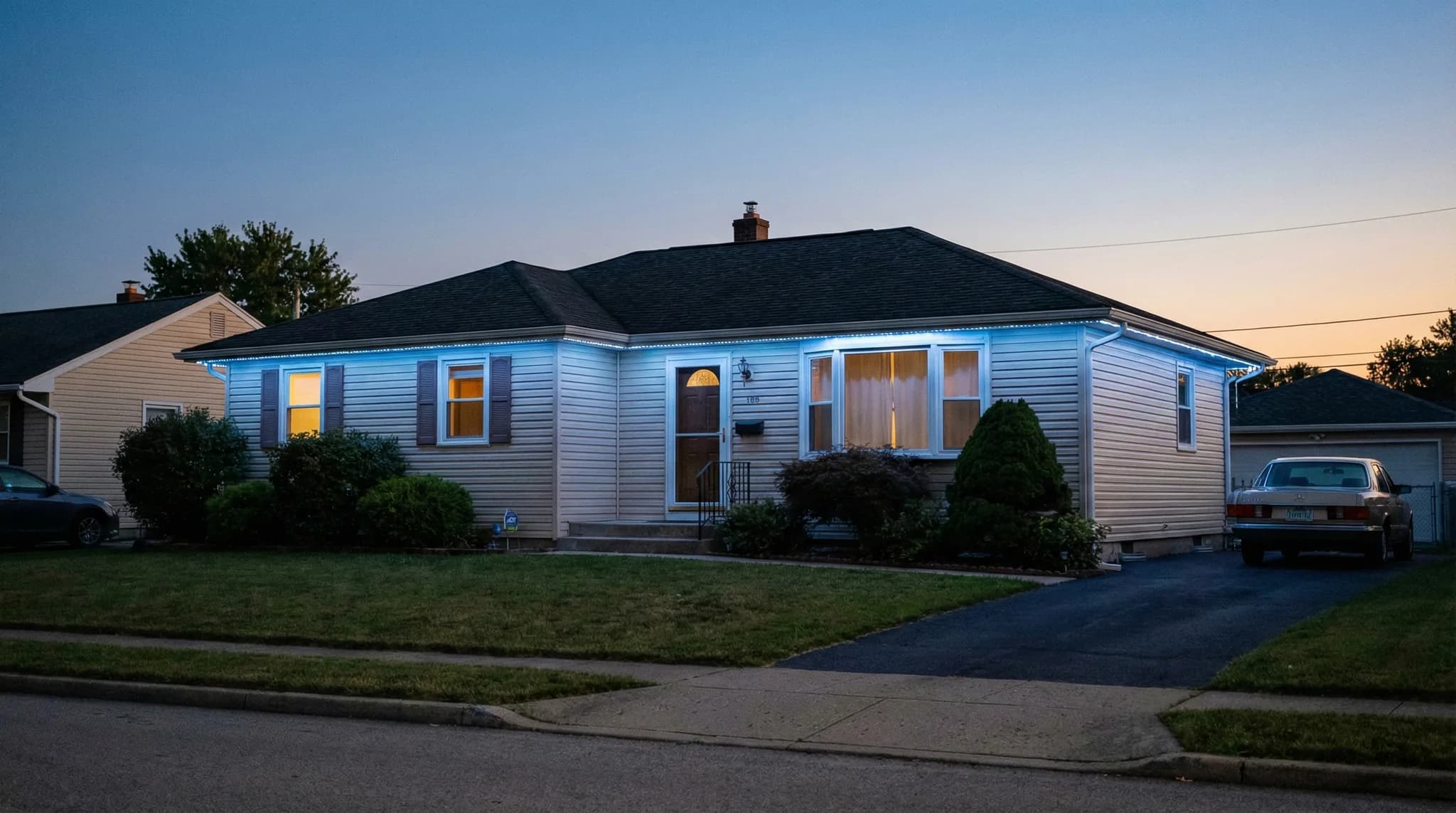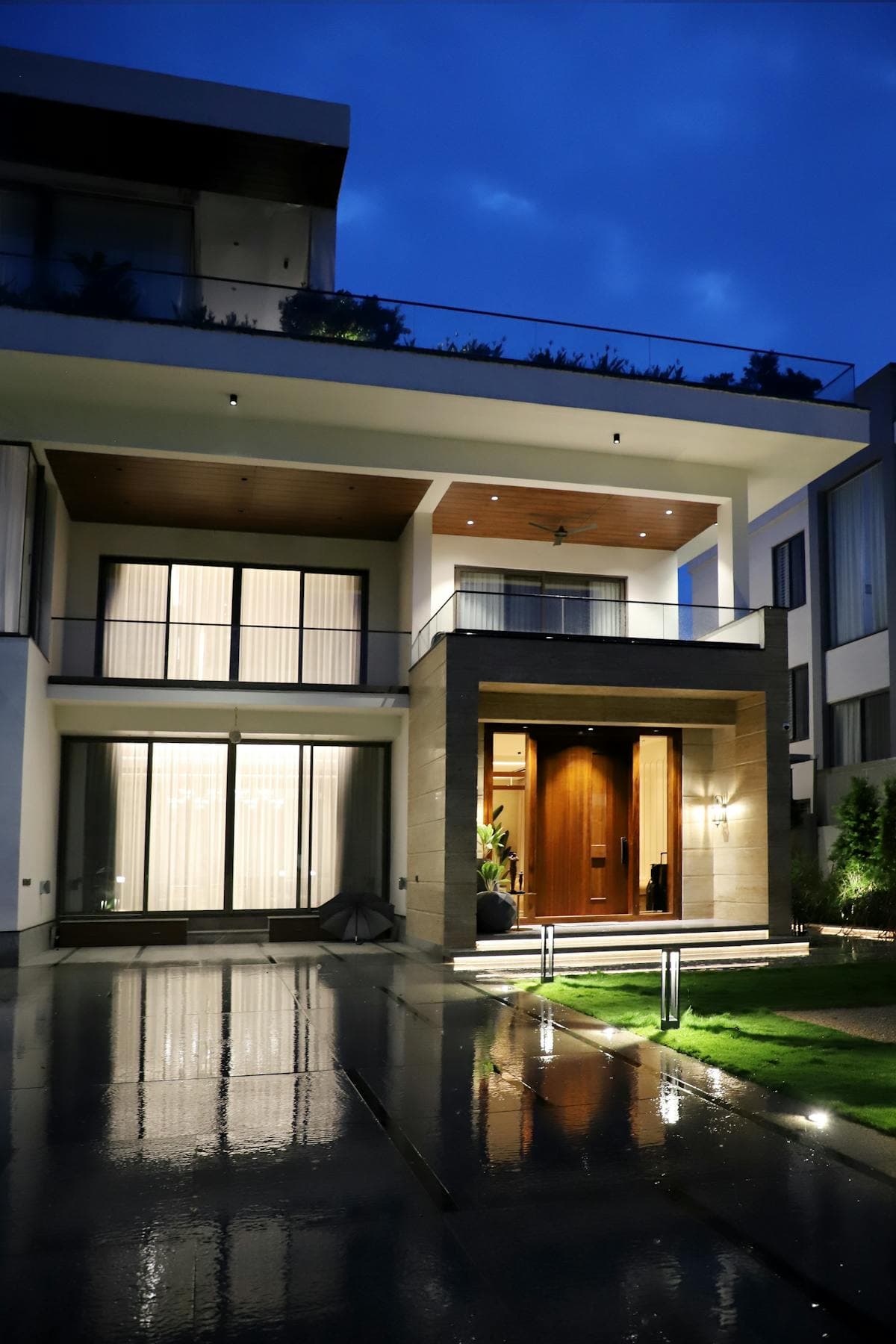
Trimlight and Jellyfish Lighting both mount along the fascia and run from a phone app – but the chip technology, warranty depth, and per-foot pricing tell two very different stories.
Trimlight vs Jellyfish comes down to four honest questions for Sacramento homeowners: Do you want individually-addressable RGBIC animations or are you fine with standard RGB? Do you trust a 3-year warranty or do you want a longer claim window? Are you willing to pay $40 to $55 per linear foot for the smoother animation engine, or does $30 to $50 land closer to your budget? And which brand actually has boots on the ground in Sacramento, Roseville, and Rocklin when a controller fails in August?
This 2026 comparison is written for Sacramento-area homeowners evaluating a $5,000 to $13,000 permanent outdoor lighting investment. EXT Lighting is a local Sacramento operator that installs and services both Trimlight and Jellyfish-style systems – and we replace failed installs from both brands regularly – so this breakdown reflects what we see in the Central Valley field, not marketing copy from a franchise brochure.
If you have not yet decided whether permanent lights make sense at all, start with our ROI and home value analysis. If you want the broader four-way picture including Gemstone, see our Trimlight vs Jellyfish vs Gemstone vs EXT Lighting comparison. Otherwise, read on for the head-to-head.
TL;DR verdict for Sacramento homeowners: Jellyfish Lighting wins on animation quality (RGBIC), app polish, and consistent pricing across dealers. Trimlight wins on track record (founded 2011 vs. 2014), warranty marketing (limited lifetime vs. 3-year), Sacramento dealer density, and lower typical price per linear foot. Pick Jellyfish if you actually plan to run Halloween chases, July 4th gradients, and Christmas animations year after year. Pick Trimlight if you want warm white 80% of the time, the deeper franchise bench, and a slightly thinner quote. Either way, confirm warranty terms in writing and verify the installer's California State License Board number before deposit.
Trimlight vs Jellyfish Verdict Table: Which Brand Wins Which Category
Before going deep on specs, here is the at-a-glance scorecard for the two brands Sacramento homeowners compare most often. Rankings reflect the typical product line available through authorized dealers in the Sacramento, Roseville, and Rocklin market in 2026.
| Category | Winner | Why |
|---|---|---|
| Best animation / color effects | Jellyfish | Individually addressable RGBIC chips |
| Best price per linear foot | Trimlight | RGB chip cost, more dealer competition in Sacramento |
| Warranty marketing | Trimlight | Limited lifetime on LEDs vs. Jellyfish 3-year |
| App polish & scheduling | Jellyfish | Smoother animation engine, larger preset library |
| Track record / brand age | Trimlight | Founded 2011 vs. Jellyfish 2014 |
| Sacramento dealer density | Trimlight | Older, larger franchise footprint in metro |
| Best for warm white 80% of the year | Tie | Both deliver acceptable RGB warm white at 2700K–3000K |
| Heat tolerance (Sacramento summer) | Tie | Both IP-rated; failure depends on install quality |
Category rankings based on 2026 product specifications published by each manufacturer and installer-reported pricing in the Sacramento metro. Exact warranty terms and pricing vary by franchisee.
Trimlight vs Jellyfish: Brand Backgrounds and Business Models
Understanding the business model behind each brand explains the pricing, the warranty claim process, and how fast your service call actually gets handled when a chip fails in mid-August. Both companies are Utah-founded franchise systems, but the franchise maturity and product strategy diverge meaningfully.
Trimlight: The Original Channel System (Founded 2011)
Trimlight is the oldest major permanent lighting brand. The company pioneered the extruded aluminum channel design that every competitor now copies, and it built the largest national franchise footprint as a first-mover advantage. Trimlight operates a national franchise model, which means the installer in Sacramento pays a royalty to corporate on every job – that royalty shows up in the price quote.
- Founded: 2011, Utah (oldest major player)
- Coverage: Largest national franchise network, multiple Sacramento-area dealers
- Chip technology: RGB on most product lines (no dedicated white, no individual addressability); newer Trimlight Edge line offers RGBW on select installs
- Mounting: Mechanical screws into fascia, aluminum channel color-matched to the home
- Warranty: Limited lifetime on LEDs (most franchises), labor coverage varies
- App: Trimlight Edge app, scheduling and scene presets, Alexa and Google Home integration
Jellyfish Lighting: The RGBIC Innovator (Founded 2014)
Jellyfish Lighting pushed the category forward with individually-addressable LEDs – every single chip can be controlled independently. That is what enables smooth chase patterns, gradient sweeps, and Halloween animations that feel cinematic rather than choppy. Jellyfish also operates a franchise model with tighter pricing discipline across dealers than Trimlight.
- Founded: 2014, Utah
- Coverage: Growing national franchise network, multiple Sacramento-region authorized dealers
- Chip technology: RGBIC (individually addressable chips), 3 LEDs per pod at typical 9-inch spacing
- Mounting: Mechanical screws, pod-style with silicone-encapsulated lens
- Warranty: 3-year on LEDs, controllers, and components; labor coverage varies
- App: Jellyfish app, larger animation library, Alexa and Google Home integration, smoother color transitions
Pro Tip
Before signing with any franchise, ask the installer point-blank who honors the warranty if their dealership closes or loses its franchise agreement. Corporate warranties usually cover the LEDs but not labor – and labor is the expensive part of a chip replacement on a two-story Sacramento fascia. Our warranty guide covers every question to ask before you put down a deposit.
Trimlight RGB vs Jellyfish RGBIC: The Chip Technology Difference
The chip type is the single most important technical difference between Trimlight and Jellyfish. It determines how your animations look, whether smooth color gradients are even possible, and how future-proof the system is for the kinds of holiday scenes Sacramento homeowners actually run. Here is the honest breakdown.
| Capability | Trimlight (RGB) | Jellyfish (RGBIC) |
|---|---|---|
| Solid-color zones (Christmas red sections, blue sections) | Yes | Yes |
| Smooth color gradients across the roofline | No (segment-based) | Yes (per-LED) |
| Cinematic chase patterns (Halloween, July 4th) | Choppy at zone boundaries | Smooth, pixel-level |
| Warm white at 2700K–3000K | Acceptable (RGB blend) | Acceptable (RGB blend) |
| Sacramento Kings purple/gold game-day scene | Yes | Yes (smoother) |
Why RGBIC wins for animation: without individual addressability, a chase pattern has to hop from one solid-color segment to the next, which looks choppy. With RGBIC, you can run a color gradient across 50 LEDs where each diode is a slightly different shade, producing the smooth rainbow sweeps and flowing patterns Jellyfish features in its marketing demos. For a deeper engineering breakdown of these chip technologies, see our RGB vs RGBW vs RGBIC deep dive.
Scoring is EXT Lighting's field-installer assessment based on 2026 product specifications and direct experience servicing both brands across the Sacramento, Roseville, Rocklin, Folsom, and Granite Bay corridor.
Trimlight vs Jellyfish Price Comparison: Sacramento 2026
Installed pricing in the Sacramento metro varies by linear feet of roofline, story count, fascia condition, and franchise overhead. Here is the realistic 2026 pricing band for both brands on a typical Sacramento single-family home, based on quotes EXT Lighting has seen across Sacramento, Roseville, Rocklin, Folsom, El Dorado Hills, and Granite Bay.
| Home size | Linear feet | Trimlight installed | Jellyfish installed |
|---|---|---|---|
| 1,500 sq ft single-story | 120–150 ft | $3,600–$7,500 | $4,800–$8,250 |
| 2,500 sq ft two-story | 200–240 ft | $6,000–$12,000 | $8,000–$13,200 |
| 3,500+ sq ft estate (Granite Bay, El Dorado Hills) | 280–360 ft | $8,400–$18,000 | $11,200–$19,800 |
| Per linear foot | $30–$50 / ft | $40–$55 / ft |
Pricing reflects authorized dealer quotes in the Sacramento metro in early 2026. Two-story homes typically push 15–25% above single-story per linear foot due to lift equipment requirements. See our full Sacramento pricing guide for additional cost detail.
The Jellyfish premium reflects three structural realities. First, the RGBIC chip costs roughly 30 to 50% more per LED than standard RGB at the manufacturing level. Second, Jellyfish corporate enforces tighter pricing discipline across its smaller dealer network, so franchisees cannot discount as aggressively. Third, Jellyfish's younger Sacramento franchise base has fewer competing dealers in any given corridor, which reduces price pressure. Trimlight's older, denser network produces more competitive bids on average.
Soft CTA: Get a Direct-to-Homeowner Quote
Both brands are franchise systems with royalty markup baked into the quote. EXT Lighting is a local Sacramento operator that skips the franchise royalty – we install commercial-grade RGBIC channel with a lifetime parts and labor warranty, typically at the lower end of the Sacramento pricing band. If you want to see what a direct-to-homeowner quote looks like alongside your Trimlight or Jellyfish bids, request a free in-home consultation. No franchise dispatch, no royalty markup – just the local-operator price.
Jellyfish vs Trimlight Warranty: What's Actually Covered
Warranty is where comparison guides usually wave their hands and move on. Here is the specific breakdown that matters for Sacramento homeowners deciding between the two brands. Always confirm the current terms in writing with your specific franchisee before deposit.
- Trimlight warranty (2026): Limited lifetime on the LEDs through most franchise locations. Labor coverage varies by franchisee – some include it for the first 1 to 5 years, others charge a service-call fee from year one. Channel and controller warranties typically run 5 to 7 years.
- Jellyfish warranty (2026): 3-year warranty on LEDs, controllers, and channel components. Labor coverage varies by dealer; corporate does not mandate inclusion. After year 3, all repairs are out of pocket unless the dealer offers an extended plan.
- The labor question: A failed LED on a 24-foot two-story Sacramento fascia requires lift equipment for replacement. A pure parts warranty covers the $40 LED segment but not the $300 to $600 service call. Verify in writing whether labor is included for the entire warranty period.
- The franchise-closure question: If your local dealer closes, who honors the warranty? Trimlight corporate generally redirects the homeowner to the nearest active franchise. Jellyfish corporate handles cases similarly. Get the corporate customer-service number written into your contract.
- The transferability question: If you sell the home, does the warranty transfer to the new owner? Trimlight and Jellyfish both typically allow one-time transfer for a small re-registration fee. Get this in writing if home sale within 5 years is plausible – lighting that pulls through to the next owner is a meaningful real-estate selling signal.
For a deeper breakdown of permanent lighting warranty terms across all major brands, see our permanent outdoor lights warranty guide.
Trimlight Edge App vs Jellyfish App: Daily-Driver Reality
The app is the product most days. After the install crew leaves, the app is how you trigger a Christmas scene, dim the lights at 11 PM, or run a Sacramento Kings purple-and-gold game-day pattern. Both brands ship a proprietary mobile app for iOS and Android with similar feature surfaces, but the underlying hardware drives meaningful differences.
What Both Apps Do Equally Well
- Scheduling: dusk-to-dawn, holiday templates, custom schedules
- Scene presets: Halloween, Thanksgiving, Christmas, Valentine's, July 4th
- Zone control: separate front, side, and back roofline zones
- Voice integration: Amazon Alexa and Google Home
- Wi-Fi connectivity (no separate hub required for most installs)
- Cloud schedule backup so a controller swap restores all settings
Where the Jellyfish App Wins
- Animation engine: Smoother gradients, longer scene libraries, and pixel-level chase animations because of the RGBIC hardware. The Trimlight Edge app cannot reproduce most of these smoothly.
- Pattern editor: The Jellyfish pattern editor lets users design custom multi-color sequences with per-pixel control; Trimlight Edge is segment-based.
- UI polish: Faster preset switching, cleaner color wheel, and a more responsive interface in our field testing across iOS 18 and Android 15.
Where the Trimlight Edge App Wins
- Simplicity: Fewer animation options means fewer decisions; warm-white-only homeowners often prefer the simpler UI.
- Stability: The older Trimlight platform has had more years to stabilize; fewer reported bugs in 2024–2026 dealer feedback.
- Integration with home automation: Trimlight Edge ships with slightly broader smart-home recipe support – see our guide on permanent outdoor lights and home automation.
Sacramento-Specific: Heat, Climate, and Local Install Reality
Both brands ship products rated for outdoor use, but Sacramento and the surrounding Central Valley produce three local stress factors that test any permanent lighting system. The chip technology difference matters less than the install-quality difference for long-term reliability in this climate.
Stress Factor 1: Central Valley Sun Fade and 110°F Summers
Sacramento, Roseville, and Rocklin routinely hit 100 to 108°F in July and August, with surface temperatures on south- and west-facing fascia exceeding 140°F. Both Trimlight and Jellyfish use UV-stable polycarbonate lenses and aluminum channel, but the failure mode in Central Valley summers is almost always adhesive on the channel or controller heat damage on a south-facing wall – not the LEDs themselves. Insist on mechanical fastening (screws, not adhesive) and a shaded controller location regardless of brand. See our Sacramento extreme heat performance guide for the field data.
Stress Factor 2: Winter Rain and Atmospheric River Events
Sacramento gets 18 to 22 inches of rain in a typical winter, with atmospheric river events producing 4 to 8 inches over a single weekend. Both Trimlight and Jellyfish use IP-rated weatherproof construction, but connector quality is the failure point we see most often in field service calls. Silicone-encapsulated connectors at every channel joint hold up; cheap pressure-fit connectors fail in 2 to 4 winter cycles. Ask any installer to show you the connector spec sheet.
Stress Factor 3: Dealer Service Response Time
When a chip fails or a controller drops Wi-Fi at 8 PM on a Saturday, local response time matters more than franchise marketing. Trimlight has the larger Sacramento dealer footprint, which produces faster response in many corridors. Jellyfish's smaller Sacramento network sometimes routes service through a single regional dealer, which can mean longer wait times. Local independents like EXT Lighting typically respond in 24 to 48 hours because there is no franchise dispatch in the loop.
Trimlight vs Jellyfish Decision Framework: Which Should You Pick?
Use the table below to map your priorities to the right brand. If your priorities split, the cleaner answer is usually whichever brand has the stronger Sacramento dealer for your corridor, regardless of chip technology.
| If your top priority is… | Pick… | Why |
|---|---|---|
| Cinematic Halloween chase animations | Jellyfish | RGBIC pixel-level animation |
| Lowest installed price | Trimlight | RGB chip cost, denser dealer competition |
| Longest warranty marketing claim | Trimlight | Limited lifetime LEDs vs. 3-year |
| Fastest Sacramento service response | Trimlight | More dealers in metro area |
| Smoothest app experience | Jellyfish | Mature animation engine, larger preset library |
| Sacramento Kings game-day scenes | Jellyfish | Smoother purple-to-gold transitions |
| Warm white 80% of the year | Either (Trimlight cheaper) | Both deliver acceptable RGB warm white |
Recommendation distribution based on EXT Lighting's 2024–2026 Sacramento, Roseville, and Rocklin homeowner consultations. Reflects which brand best matches each homeowner's stated priority profile.
How to Verify Your Trimlight or Jellyfish Sacramento Installer
The brand decision matters less than the installer decision. A great installer with Trimlight beats a mediocre installer with Jellyfish every time. Run any Sacramento-area dealer through this checklist before deposit.
- License verification: Look up the contractor on the California State License Board (cslb.ca.gov). They should hold either a C-10 electrical or C-7 low-voltage license, with no unresolved complaints in the past 24 months.
- Insurance: Request a Certificate of Insurance with general liability minimum $1M and active workers comp. Two-story Sacramento installs without workers comp are a homeowner liability problem if a crew member falls.
- Recent corridor photos: Ask for 5+ photos of completed installs in your specific corridor (Sacramento city, Roseville, Rocklin, Folsom, El Dorado Hills, Granite Bay) from the past 12 months. Stock manufacturer photos do not count.
- Mounting method confirmed in writing: Mechanical screws, not adhesive. Adhesive fails on south-facing fascia in Sacramento summer. The contract should explicitly state mechanical fastening with stainless or coated screws.
- Warranty terms in writing: Get the parts warranty, labor warranty, and franchise-closure provisions on the contract, not just a marketing brochure.
- HOA approval handling: If you live in an HOA (Roseville, Rocklin, Folsom, El Dorado Hills, Granite Bay subdivisions all carry many), confirm the installer handles or supports the architectural review submittal. Our Sacramento HOA rules guide covers what most boards expect.
- Two written quotes minimum: Compare line items, not just bottom lines. Watch for “channel only” quotes that exclude controller, transformer, or junction box upgrades.
For the long-form version of this checklist with sample contract language, see our how to choose a Sacramento installer guide.
Mini-Case Study: Two Sacramento Homeowners, Two Different Brands
Two Sacramento neighbors approached us in the same month with opposite priorities. Both ended up happy – with different brands. The contrast illustrates why “better” is the wrong question.
Homeowner A: Land Park, Single-Story, 165 Linear Feet
Priorities: warm white year-round, occasional Christmas red and green, simplest possible app, lowest reasonable price. Decision: Trimlight. The RGB chip set delivered acceptable warm white at 2700K, the Trimlight Edge app surface stayed simple, and the local franchisee's quote came in at $5,200 installed. Two years later, no service calls, owner reports satisfaction with daily-driver warm white.
Homeowner B: East Sacramento, Two-Story, 215 Linear Feet
Priorities: cinematic Halloween chases for the family Halloween party, July 4th red-white-blue gradients, Sacramento Kings purple-and-gold on game nights, willing to pay a premium for animation quality. Decision: Jellyfish. The RGBIC chip set produced the smooth chase patterns the homeowner specifically wanted, and the Jellyfish app animation library matched the use case. Quote came in at $9,800 installed. One service call in year two for a controller Wi-Fi drop (resolved by the local Jellyfish dealer in 36 hours).
Both decisions were correct. Both homeowners would have been unhappy with the opposite brand. Use-case fit beats brand loyalty every time.
Frequently Asked Questions: Trimlight vs Jellyfish
Is Trimlight better than Jellyfish?
Neither brand is universally better – they win different categories. Trimlight has the longer franchise track record and lower typical pricing. Jellyfish wins on animation quality because of RGBIC chips. For a homeowner who runs warm white 80% of the year, Trimlight is the safer pick. For a homeowner who plans to run Halloween chases and Christmas animations regularly, Jellyfish is worth the premium.
What's the difference between Trimlight and Jellyfish?
Four real differences: chip technology (Trimlight RGB vs. Jellyfish RGBIC), warranty (Trimlight limited lifetime on LEDs vs. Jellyfish 3-year), animation quality (Jellyfish smoother due to per-pixel addressability), and price ($30–$50/ft for Trimlight vs. $40–$55/ft for Jellyfish in the Sacramento market).
Which lasts longer, Trimlight or Jellyfish?
Both systems are rated for 50,000+ LED hours. Real-world Sacramento lifespan depends more on install quality than brand – specifically mechanical mounting, silicone-encapsulated connectors, and a shaded controller location. Both brands have produced 12+ year installs and both have failed in 4 years when installed poorly. See our permanent outdoor lights lifespan guide for the field data.
Does Jellyfish have a lifetime warranty?
No. Jellyfish Lighting carries a 3-year warranty on LEDs, controllers, and components as of 2026. Trimlight markets a limited lifetime warranty on LEDs through most franchises, though labor coverage and the “limited” definition vary by franchisee. Always confirm warranty terms in writing before deposit.
Trimlight Edge app vs Jellyfish app – which is better?
The Jellyfish app produces smoother animations because of the underlying RGBIC hardware. Trimlight Edge is more conservative in its animation library, reflecting the RGB chip architecture. Both apps offer scheduling, scene presets, and Alexa/Google Home integration. For animation, Jellyfish wins. For warm-white-only operation, both are roughly equivalent.
How much does Trimlight cost vs Jellyfish in Sacramento?
Trimlight runs $30 to $50 per linear foot installed in the Sacramento, Roseville, and Rocklin market. Jellyfish runs $40 to $55 per linear foot. A typical 2,000 to 2,800 sq ft home averages $5,400 to $12,000 with Trimlight and $7,200 to $13,200 with Jellyfish.
Which brand has more Sacramento dealers?
Trimlight, by a meaningful margin. Trimlight's older 2011 founding produced a denser franchise footprint in the Sacramento metro than Jellyfish's 2014 entry. Higher dealer density usually means faster service response and more competitive quotes.
The Honest Sacramento Recommendation
Both Trimlight and Jellyfish are legitimate franchise systems that produce good outcomes when installed by a quality Sacramento dealer. The brand differences described above are real, but they matter less than the installer differences in 80% of cases. Get two quotes, verify CSLB licensing, insist on mechanical mounting, and confirm the warranty terms in writing.
EXT Lighting installs and services both brand-equivalent systems across Sacramento, Roseville, Rocklin, Folsom, El Dorado Hills, Granite Bay, and Elk Grove. We use commercial-grade RGBIC channel comparable to Jellyfish's product line, mount mechanically, skip the franchise royalty, and back the install with a lifetime parts and labor warranty. Request a free in-home consultation if you want a third quote alongside your Trimlight and Jellyfish bids – or browse our full Sacramento brand comparison guide for the broader market view.